
How Neurodevelopment Works
Your child's brain is constantly learning from the world around them.
From the earliest movements and sensory experiences to crawling, walking, communicating, focusing, and regulating emotions, development happens through an ongoing conversation between the brain, body, and environment.
Neurodevelopment is the process through which the brain and nervous system grow, organize, and adapt over time. Genetics provide an important foundation, while movement, sensory input, relationships, repetition, and everyday experiences continually help shape developing neural pathways.
Understanding this process can help parents look beyond individual milestones and begin seeing how different areas of development—and the health of the nervous system supporting them—are connected.
Explore How Development BuildsDevelopment Is More Than Meeting Milestones
Milestones are valuable markers of development, but neurodevelopment is much more than a checklist of when a child sits, crawls, walks, talks, or learns.
Each new ability develops alongside many underlying processes. A baby begins by developing greater control of the head and body. Movement becomes increasingly purposeful. The child learns to coordinate both sides of the body, navigate gravity and space, interpret sensory information, and eventually perform increasingly complex movements and tasks.
At the same time, the nervous system is continually receiving information from both inside and outside the body, organizing that information, and adapting its responses. Movement, sensory processing, regulation, communication, attention, and learning do not develop in completely separate compartments.
“They are parts of one developing child and one continually adapting nervous system.”
The Brain Develops Through Experience
Neuroplasticity
One of the remarkable characteristics of the nervous system is its ability to change and adapt in response to experience—a property known as neuroplasticity.
Every day, a developing child receives enormous amounts of information through movement, touch, vision, sound, balance, interaction, play, relationships, and the environment. As children repeatedly move, explore, communicate, practice skills, and solve problems, the nervous system continually responds to those experiences.
This is one reason meaningful experiences, repetition, movement, appropriate challenge, connection, and opportunities for exploration are so important throughout childhood. Neuroplasticity does not mean that every developmental challenge can simply be “rewired,” nor that one particular intervention creates a predictable developmental outcome.
“The developing nervous system is not passive. It is continually receiving information, responding to experience, and adapting.”
Movement Gives the Brain Information
When we think about movement, we often picture the brain telling the body what to do: reach for the toy, take a step, climb the stairs. But communication does not travel in only one direction.
“Movement also provides information back to the nervous system.”
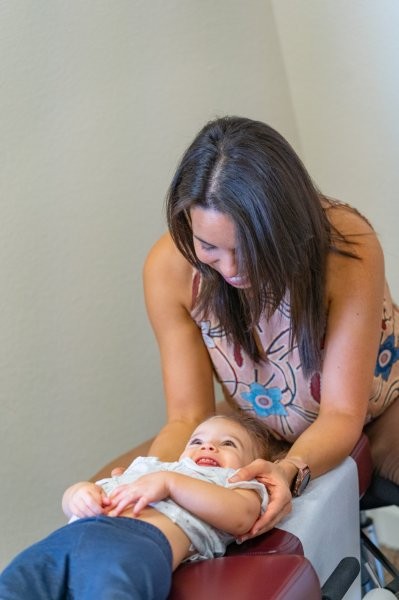
As a child rolls, reaches, crawls, climbs, balances, jumps, and explores, sensory receptors throughout the body continually provide information about position, movement, pressure, balance, and the surrounding environment.
Proprioception
Receptors associated with muscles and joints provide information about body position and movement—helping the nervous system understand where the body is and what it is doing.
Vestibular Input
The vestibular system provides information related to movement, gravity, balance, spatial orientation, and head position.
Touch
The sensory system associated with the skin provides information about contact, pressure, texture, temperature, and other physical sensations.
The nervous system integrates these signals with information from vision, hearing, and other senses to continually guide and refine the child's responses.
“Movement isn't simply an output of the nervous system. It is also an important source of sensory input.”
Where Chiropractic Fits Into the Conversation
Parents often first encounter chiropractic as something adults use when their back or neck hurts. Pediatric chiropractic looks at a much broader relationship between movement, the neuromusculoskeletal system, and the nervous system.
The spine is not simply a stack of bones protecting the spinal cord. It is a highly mobile part of the body surrounded by joints, muscles, and sensory receptors that continually contribute information about movement and position. That proprioceptive information becomes part of the enormous amount of sensory input the nervous system receives and processes every day.
This relationship between movement, sensory input, and nervous-system function is one reason our approach places so much importance on healthy spinal and joint mobility. At Mojica Chiropractic Care, we assess how the spine and joints are moving and functioning within the context of the whole child. Gentle, age-appropriate chiropractic adjustments are used to address areas of joint dysfunction and support appropriate movement and neuromusculoskeletal function. Our perspective extends beyond pain.
“WE SEE MOVEMENT AS INFORMATION.”
Because the nervous system continually learns and adapts through information from the body and environment, we believe healthy movement and sensory input are important parts of supporting a child's developing nervous system.
Chiropractic care is not a treatment for a child's neurodevelopmental diagnosis. Our focus is supporting neuromusculoskeletal and nervous-system function as part of a larger whole-child approach to health and development.
Development Builds in Layers
Although every child develops differently, early development generally progresses from foundational abilities toward increasingly complex movement and participation.
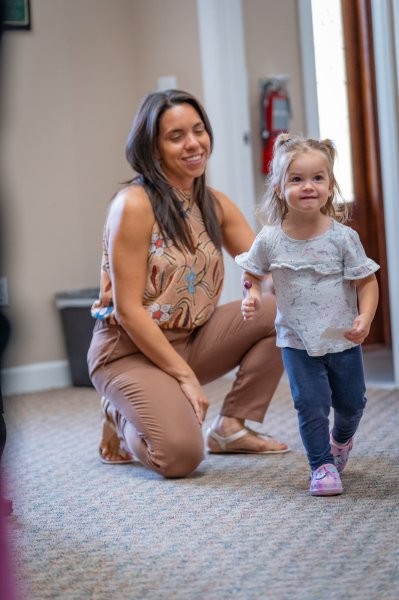
As children gain experience moving their bodies through the world, they encounter opportunities to develop increasingly complex abilities involving:
Development is dynamic rather than perfectly linear, and children do not all follow identical timelines or trajectories. Sometimes a child finds a different strategy for accomplishing a task when a particular movement or sensory-motor skill is difficult.
These compensations are not inherently bad. They demonstrate something remarkable about the nervous system: it adapts and finds another way to accomplish the task. But observing how a child moves and completes a task can sometimes tell us more than simply checking whether the milestone was eventually achieved.
What About Primitive Reflexes?
Primitive reflexes are automatic movement responses present early in life that play important roles during infancy and early development.
As the nervous system matures and children gain increasing control over movement, these early reflex-driven responses typically become less dominant while increasingly voluntary and coordinated movement emerges. When certain primitive reflex responses remain strongly expressed beyond the developmental period when they would typically be expected to diminish, they can provide one piece of information about a child's sensory-motor development.
Primitive reflex findings should not be interpreted in isolation. We consider them alongside the child's developmental history, movement patterns, coordination, sensory responses, regulation, and functional abilities.
Regulation Is Part of Development, Too
A child's nervous system is constantly receiving information and determining how to respond. Is it time to move or become still? Pay attention or look elsewhere? Engage or withdraw? Stay alert or settle into rest?
Regulation is the nervous system's ongoing ability to adapt its state and responses to what is happening within the body and in the environment. As children develop, they gradually build greater capacity to move between activity and rest, maintain attention, tolerate different sensory experiences, manage frustration, transition between activities, and recover following excitement or stress.
Regulation is influenced by the whole child—including movement and sensory input, sleep, nutrition, physical health, relationships, environment, stress, temperament, and individual development. This is why our approach does not look at regulation or behavior in isolation.
“CHIROPRACTIC CAN BE ONE PART OF A WHOLE-CHILD APPROACH TO NERVOUS-SYSTEM REGULATION.”
Because movement of the spine and joints continually contributes sensory and proprioceptive information to the nervous system, our chiropractic approach focuses on supporting healthy joint mobility, movement, and neuromusculoskeletal function. For many families, chiropractic becomes one component of a broader lifestyle focused on supporting the child's nervous system—not only something they seek when their child is experiencing pain.
Looking at the Whole Child
When a child is struggling, families often encounter separate descriptions for separate concerns: coordination, sensory seeking or avoidance, attention, emotional regulation, speech and communication, motor development, learning, and behavior.
But children do not develop in isolated compartments. Movement influences sensory experiences. Sensory information influences how a child interacts with the environment. Attention, regulation, communication, motor planning, sleep, health, relationships, and experience continually interact.
Instead of asking only,
“What is my child struggling with?”
also ask,
“How is my child moving, developing, adapting, and experiencing the world around them?”
“That broader question is at the heart of our approach.”
Supporting the Whole Child Takes a Team
No single profession holds every piece of a child's developmental picture. Depending on the child's individual needs, their team may include chiropractic care alongside pediatric medicine, occupational therapy, physical therapy, speech-language therapy, developmental specialists, educators, mental-health professionals, nutrition professionals, and others. Each discipline brings a different perspective.
“OUR ROLE IS THE NEUROMUSCULOSKELETAL AND NERVOUS-SYSTEM PIECE.”
At Mojica Chiropractic Care, we look closely at spinal and joint mobility, movement, sensory-motor experiences, developmental history, and the sensory information the body continually provides to the nervous system. We use gentle, age-appropriate chiropractic care to support healthy joint movement and neuromusculoskeletal function while continually considering how the child is functioning as a whole. When another professional's expertise is needed, integration is part of the plan. Our goal is not for one profession to do everything.
“Our goal is to give each child the strongest possible foundation and the right combination of support to move, learn, adapt, participate, and develop to their individual potential.”
A Different Way to Think About Chiropractic
Chiropractic is often associated only with back pain, neck pain, or injuries. Those are certainly reasons people seek care—but they don't tell the entire story of why families choose chiropractic.
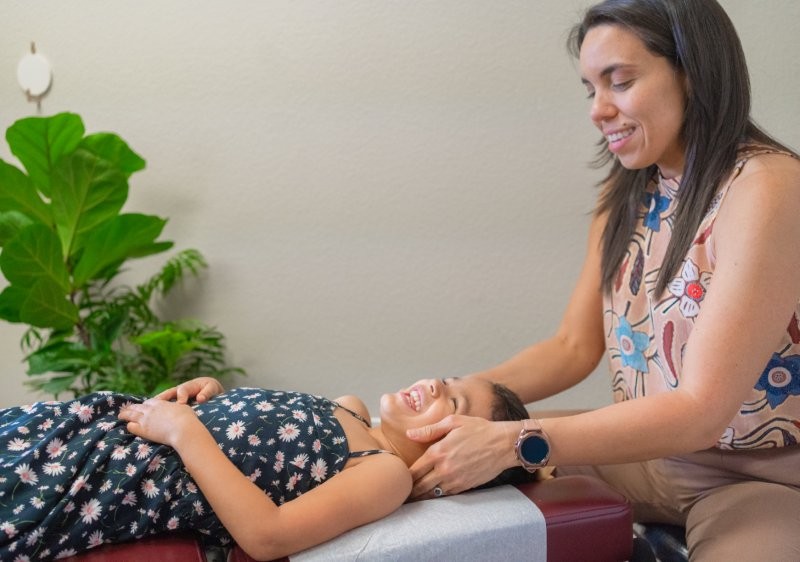
Our approach begins with a broader understanding of the relationship between the spine, movement, sensory input, and nervous system. For children, that means care looks very different from adult pain management. Adjustments are gentle and age-appropriate, and our attention is focused on how the child is moving and functioning—not simply whether something hurts.
“We don't believe chiropractic is the answer to every developmental challenge.”
“We believe it is one meaningful way to support the body and nervous system a child uses to move through, experience, and learn from the world.”
When Parents Begin Asking More Questions
Parents often begin exploring neurodevelopment because something about their child's development simply catches their attention.
Perhaps milestones are taking longer than expected.
Movement looks different or requires extra effort.
Their child constantly seeks movement—or strongly avoids certain sensations.
Transitions are difficult.
Attention is challenging.
Communication is developing differently.
Or several concerns that seemed unrelated begin appearing together.
These observations do not automatically tell us why something is happening. But they can be valuable invitations to look more closely at the whole child rather than focusing on one symptom at a time.
Explore More About Your Child's Development
Developmental Milestones & Concerns
Understand how developmental patterns progress across movement, communication, learning, and regulation.
Crawling & Movement Concerns
Explore how early movement provides sensory-motor experiences and why movement quality matters.
Sensory & Regulation Challenges
Learn how children receive and respond to information from their body and environment.
Attention, Behavior & Neurodevelopment
Look beneath attention and behavior to understand broader developmental patterns.
Primitive Reflexes & Development
How early reflex patterns relate to developing voluntary movement and sensory-motor function.
Autism & Neurodevelopmental Support
Coming soon. A whole-child approach to supporting autistic children and their individual developmental needs.
ADHD, Attention & Regulation
Coming soon. Understanding attention and regulation within a larger developmental and nervous-system picture.
Motor Planning, Coordination & Body Awareness
Coming soon. How sensory information and movement work together as children learn to plan and coordinate their bodies.
Speech, Communication & Development
Coming soon. Exploring communication within the broader developmental picture.
Emotional Regulation & Meltdowns
Coming soon. Understanding regulation, sensory demands, stress responses, and the individual child.
Have Questions About Your Child's Development?
Every child has their own developmental story. If you have questions about your child's movement, milestones, sensory experiences, regulation, or development, we're here to help you understand the bigger picture.
At Mojica Chiropractic Care, our pediatric approach looks beyond pain to consider movement, spinal and joint function, sensory-motor development, and nervous-system function within the context of the whole child.
Mojica Chiropractic Care · Winter Springs, Florida · Serving families in Winter Springs, Oviedo, and surrounding Central Florida communities.