
Crawling & Movement Concerns
One baby crawls on hands and knees. Another belly crawls. Another scoots across the floor. And some children seem ready to pull up and walk without spending much time crawling at all.
There is more than one way for babies to learn how to move. What can be especially helpful is looking beyond which movement your child uses and asking:
How are they using their body to do it?
Are both sides participating? Can they transition between positions? Do movements seem comfortable and coordinated? Are they progressing toward new skills? When something about your child's movement repeatedly catches your attention, it may be worth taking a closer look.
Noticing Something Different in Your Child's Movement? Let's Take a Closer LookThere Is More Than One Way to Get Across the Room
Babies may move across the floor using several patterns, including:
- Traditional hands-and-knees crawling
- Belly or commando crawling
- Bear crawling on hands and feet
- Bottom scooting
- Rolling to reach objects
- Sideways or unusual crawling patterns
- A combination of several movement styles
Some children may not spend much time crawling before beginning to pull to stand, cruise, or walk.
Skipping traditional hands-and-knees crawling does not automatically mean that something is wrong, and there is no good evidence that simply skipping crawling causes later reading, learning, ADHD, or developmental disorders.
What we are more interested in is the overall developmental picture and quality of movement.
When Movement Deserves a Closer Look
Parents may notice that their child:
- Consistently uses one side more than the other
- Drags one leg while crawling
- Avoids putting weight through one arm
- Pushes primarily with one side
- Scoots using the same leg repeatedly
- Crawls with one knee down and one foot planted
- Has difficulty transitioning from sitting to the floor
- Cannot easily move in and out of positions
- Seems unusually stiff or unusually floppy
- Frequently falls toward the same side
- Has difficulty balancing while sitting
- Avoids tummy time or weight-bearing through the arms
- Moves in a way that seems effortful or uncomfortable
- Has stopped progressing toward new movement skills
- Has lost a movement skill they previously used
One unusual movement does not necessarily indicate a problem. Persistent asymmetry, weakness, loss of skills, or difficulty progressing deserves more attention.
Why Crawling Can Be an Important Developmental Experience
Crawling is more than a way to get across the room. It gives babies repeated opportunities to coordinate opposite sides of the body, shift weight, stabilize through the shoulders and trunk, move the hips, explore space, and process sensory information through the hands, knees, joints, muscles, eyes, and vestibular system.
Not every child crawls in exactly the same way or for the same length of time. The concern is not whether a child performed one textbook movement perfectly. We are more interested in whether they experienced the underlying movement opportunities and whether later skills are developing efficiently.
When crawling is skipped, very brief, markedly asymmetrical, or replaced by a persistent compensatory pattern, it may be useful to evaluate what movement experiences the child is receiving and whether mobility, coordination, sensory processing, or developmental organization deserve a closer look.
That is why we pay attention not only to whether a child moves—but how they organize the movement.
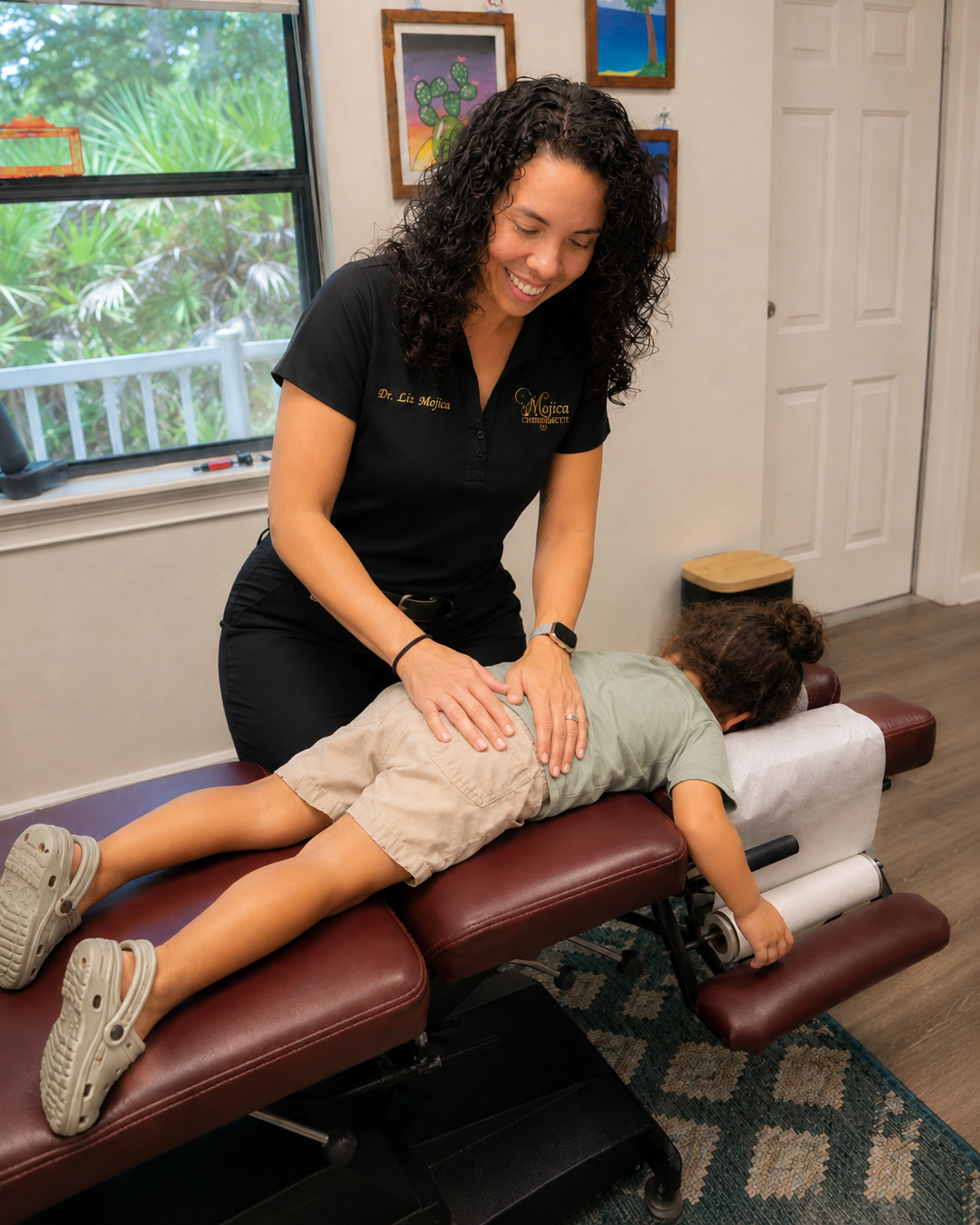
Movement Begins With a Body That Can Move Comfortably
Every developing movement requires multiple joints and body regions to work together. Rolling requires movement through the neck, spine, shoulders, pelvis, and hips. Sitting requires trunk control and the ability to shift weight. Crawling involves coordinated movement through the shoulders, spine, pelvis, hips, arms, and legs.
When a joint is not moving comfortably through its available range, a child may naturally find another strategy to accomplish the movement. That does not mean joint restriction causes developmental delay.
But comfortable mobility provides children with more opportunities to explore varied movement patterns without having to continually compensate around an area that is difficult to move.
At Mojica Chiropractic Care, assessing spinal and joint mobility is one of the foundational ways we look at a growing child's movement.
Every Movement Provides Information
Movement creates continuous sensory information for the developing nervous system. As a baby pushes against the floor, shifts weight, reaches for a toy, rotates the trunk, or moves from sitting toward crawling, the brain receives information about:
- Where the body is in space
- Where the arms and legs are positioned
- How much force is needed
- How balance changes
- How one side coordinates with the other
- How to plan the next movement
Through repetition and experience, children gradually develop increasingly complex voluntary movement. Healthy movement experiences are therefore an important part of development.
Our goal is not to claim that an adjustment creates a developmental milestone. It is to support the physical mobility that allows children to continue exploring movement.
Watching Your Child Move Tells Us a Lot
When a family comes to Mojica Chiropractic Care because they are concerned about crawling or movement, Dr. Liz may look at:
- Spinal and joint mobility
- Neck movement
- Shoulder mobility and weight-bearing
- Trunk rotation
- Pelvic and hip movement
- Body symmetry
- Right-to-left coordination
- Sitting balance
- Weight shifting
- Movement transitions
- Crawling pattern
- Use of both arms and legs
- Posture
- Overall movement quality
- Developmental milestone history
- Primitive reflex patterns when appropriate
- Sensory and proprioceptive responses
- Nervous system regulation
We are not looking for one "perfect" crawling pattern. We are looking at how efficiently and comfortably the child's body works together.
Start With the Foundation: Mobility
For families who notice an unusual movement pattern, pediatric chiropractic care can provide a gentle, conservative assessment of spinal and joint mobility.
Dr. Liz uses age-appropriate chiropractic techniques when restricted mobility or physical tension is identified. Care may focus on supporting:
- Joint mobility
- Comfortable movement
- Symmetry
- Posture
- Body awareness
- Adaptability
- Nervous system regulation
Sometimes improving the physical environment for movement is an appropriate first step. Then we watch what the child does with that opportunity. Does movement become easier? Do they begin exploring more positions? Does persistent asymmetry remain? Do broader coordination or developmental concerns become more apparent?
Those observations help determine whether additional developmental support may be useful.
What If It's More Than Joint Mobility?
Sometimes a child's movement pattern involves more than physical restriction. Parents may also notice:
- Difficulty coordinating both sides of the body
- Poor balance
- Trouble planning new movements
- Persistent primitive movement patterns
- Sensory sensitivities
- Difficulty with body awareness
- Frequent crashing or seeking intense movement
- Fine-motor challenges
- Difficulty transitioning between activities
- Broader developmental delays
When these patterns are present, we may want to look more deeply at how the child's motor, sensory, and developmental systems are working together. That is where Rooted Pathways may become the next step.
When Movement Tells Us There May Be More to Explore
Rooted Pathways: A Neurodevelopment Program is designed for children whose movement, coordination, sensory regulation, developmental milestones, or primitive reflex patterns suggest that they may benefit from a more comprehensive developmental assessment.
The occupational therapy component will allow us to look beyond joint mobility and evaluate how the child is using movement in everyday function. Primitive reflex findings will be considered as one part of the broader developmental picture, rather than being used alone to diagnose a developmental or neurobehavioral condition.
Explore Rooted PathwaysFrom Automatic Movement Toward Voluntary Control
Babies are born with automatic movement responses known as primitive reflexes. These reflexes serve important roles during early infancy. As the nervous system develops, voluntary movement gradually becomes more dominant and many primitive reflex responses become less prominent.
When a child's movement, coordination, sensory responses, or developmental history raises questions, primitive reflex patterns may be one component evaluated during a broader developmental assessment.
A primitive reflex finding by itself does not tell us why a child is struggling, nor does it diagnose autism, ADHD, developmental delay, or another condition. It gives us one more piece of information about how the child is organizing movement.
Don't Panic If Your Child Skipped Traditional Crawling
Parents often hear statements such as: "If your baby skips crawling, they will have learning problems," or: "Every child has to crawl before walking."
That is not supported by current pediatric evidence. Some typically developing children use alternate mobility patterns or skip traditional hands-and-knees crawling entirely.
Rather than assuming a skipped crawling stage created a later problem, we look at the child's overall development. Questions that may be more useful include:
- Are both sides of the body being used?
- Is the child continuing to gain new skills?
- Are they able to transition between positions?
- How are balance and coordination developing?
- Is movement comfortable?
- Are there concerns in multiple areas of development?
Movement patterns provide information. They should not be used to frighten parents.
Give Children Opportunities to Explore Movement
Babies learn movement through experience. When developmentally appropriate, provide plenty of safe opportunities for:
- Supervised tummy time
- Floor play
- Reaching for toys
- Rolling
- Moving between different positions
- Playing on both sides
- Weight-bearing through the arms
- Exploring movement without restrictive equipment
- Crawling over safe cushions or obstacles once ready
- Playing with toys placed in different directions
Try not to rush children into standing or walking before they begin exploring those skills themselves. Floor time gives children space to discover how their bodies work.
Some Movement Patterns Need Additional Evaluation
Discuss your child's movement with their pediatrician when you notice:
- One arm or leg moving significantly less than the other
- Persistent one-sided weakness
- Inability to sit independently around the expected developmental window
- Significant stiffness or floppiness
- Persistent asymmetrical movement
- Frequent falling or loss of balance beyond what seems developmentally expected
- Difficulty bearing weight on an arm or leg
- Pain with movement
- Development that has stopped progressing
- Loss of a skill your child previously had
- Concerns across multiple areas of development
Developmental monitoring tools can help parents recognize patterns, but they do not replace standardized screening or professional evaluation.
Movement Is Connected to the Bigger Developmental Picture
Developmental Milestones & Concerns
Are there other milestones that your child has reached differently or later than expected?
Learn MoreSensory & Regulation Challenges
Does your child seek constant movement, avoid certain sensations, or struggle to organize their body?
Learn MoreAttention, Behavior & Neurodevelopment
Are movement concerns occurring alongside communication, attention, behavior, or developmental differences?
Learn MoreMobility Before Complexity
Complex movement depends on many parts of the body being able to move and coordinate together. Dr. Liz is certified in chiropractic pediatrics and uses gentle, individualized care to assess spinal and joint mobility throughout a child's development.
Explore Pediatric Chiropractic CareDifferent Doesn't Automatically Mean Wrong—But Patterns Are Worth Understanding
Your child does not have to move exactly like another child. But if you repeatedly notice asymmetry, difficulty transitioning, unusual movement patterns, or a child who seems to work much harder than expected to move their body, those observations are worth exploring.
Learn More
My Baby Crawls Differently—Should I Be Concerned?
Explain different crawling styles, normal variation, and movement patterns that deserve additional attention.
Read MoreDoes My Baby Have to Crawl Before Walking?
Correct the common myth that every child must crawl traditionally before walking or they will develop learning problems.
Read MoreWhy Does My Baby Use One Side More Than the Other?
Explore persistent asymmetry, head preference, joint mobility, strength, coordination, and when evaluation may be appropriate.
Read More