Birth Stress & Difficult Deliveries
Every birth is different. Some babies arrive after a calm, uncomplicated labor. Others experience a very long labor, a rapid delivery, a C-section, vacuum or forceps assistance, unusual positioning, shoulder dystocia, or other unexpected circumstances.
Afterward, parents may begin noticing little things:
- "My baby always looks one way."
- "Feeding is much easier on one side."
- "They seem tense when I hold them this way."
- "Tummy time is really difficult."
- "My baby just doesn't seem comfortable."
A difficult birth does not automatically mean something is wrong with your baby. But birth history can provide valuable context when we are trying to understand the movement, positioning, feeding, and physical patterns parents notice during those first weeks and months.
Was Your Baby's Birth Difficult? Let's Look at How They're Moving NowBirth Places Physical Demands on Both Mom and Baby
Labor and delivery naturally involve pressure, movement, positioning, and rapid physical changes. Most babies adapt beautifully.
Sometimes, however, a birth may involve circumstances that make parents and healthcare providers pay closer attention afterward. These may include:
- Very long labor
- Very rapid labor
- Difficult fetal positioning
- Breech or other non-head-down presentation
- Vacuum-assisted delivery
- Forceps-assisted delivery
- Unplanned C-section
- Difficult extraction during C-section
- Shoulder dystocia
- Large baby
- Prematurity
- Significant molding, swelling, or bruising
- Other complications during labor or delivery
These experiences do not automatically create a chiropractic problem. They simply become part of the history we consider when evaluating how a newborn is moving and functioning after birth.
Sometimes the Clues Are Subtle
When a parent later notices:
- • Head preference
- • Body asymmetry
- • Feeding difficulty
- • Limited movement
- • Persistent tension
- • Difficulty tolerating positions
birth history becomes one useful part of understanding the pattern.
Many of these signs can have several possible explanations. The goal is not to blame the birth. It is to recognize patterns and determine whether they deserve a closer look.
Birth History Gives Us Context—But Current Function Tells Us What Matters Now
Pregnancy and birth expose the baby to positioning, compression, rotation, rapid movement, and physical adaptation. Most babies adapt well.
Parents sometimes worry that a difficult delivery permanently harmed their baby. That is not the message we want families to take away.
Most newborns adapt well after birth, and many common findings such as temporary head molding or minor bruising resolve naturally. What matters most to us is:
How is your baby moving now?
Can they:
- Turn comfortably both directions?
- Move both arms and legs?
- Relax into different positions?
- Feed comfortably?
- Tolerate supervised tummy time as they develop?
- Move with reasonable symmetry?
- Progress through early developmental skills?
Your baby's current movement tells us much more than the birth story alone.
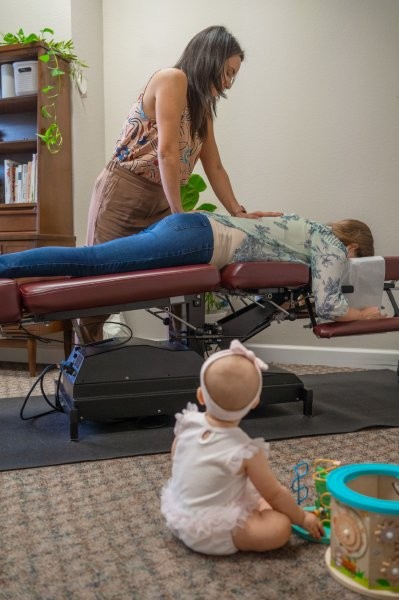
How your baby is moving now matters more than the birth story alone.
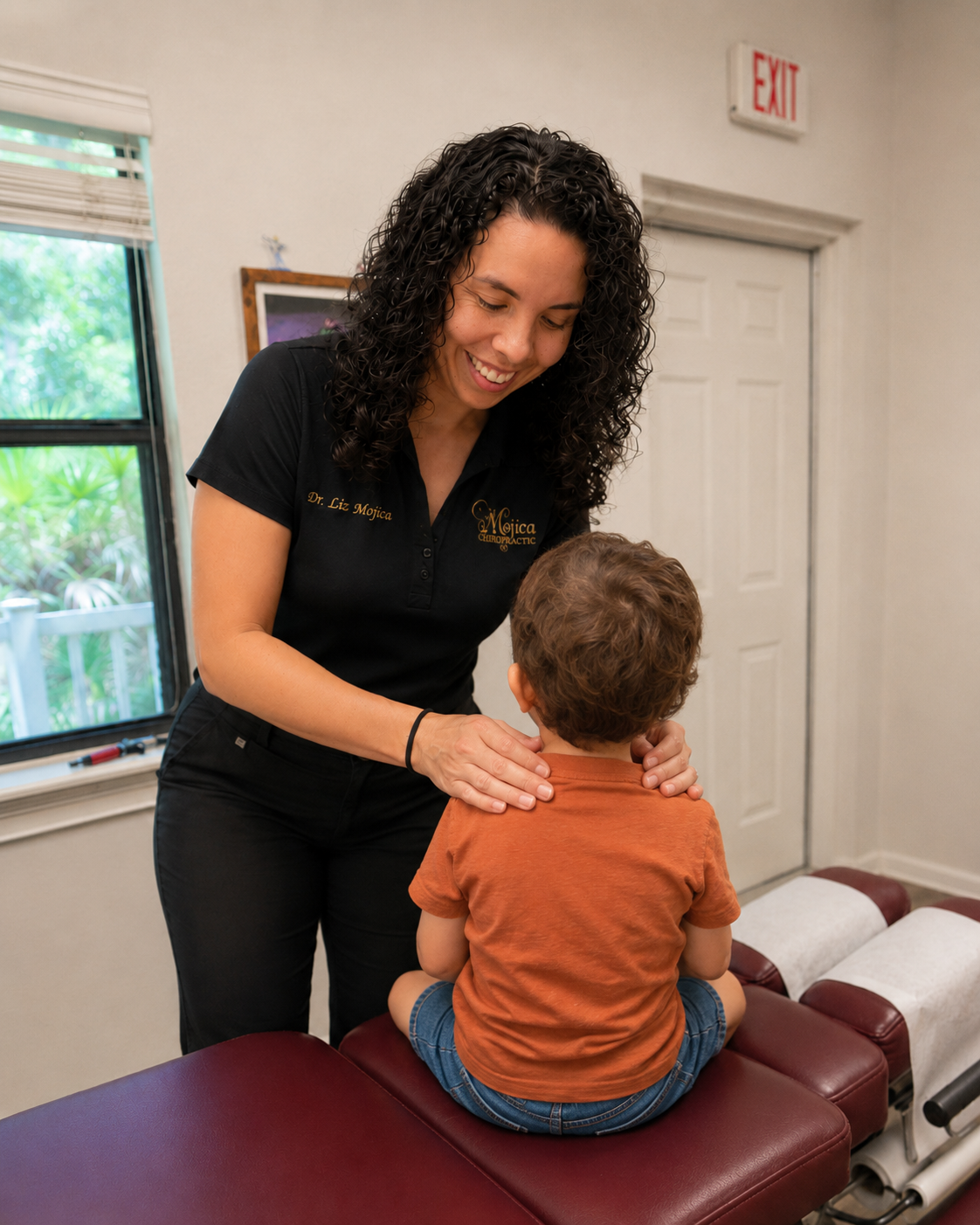
Early Development Begins With Simple Movement
During the first months of life, babies build skills through repeated movement and sensory experiences. Before rolling, sitting, crawling, or walking, they begin with:
- Turning the head
- Moving arms and legs
- Bringing the hands toward the body
- Lifting during tummy time
- Looking toward people and sounds
- Shifting weight
- Exploring different positions
Comfortable joint mobility gives a baby more opportunities to experience these movements.
When movement consistently appears restricted, asymmetrical, or uncomfortable, it can be worthwhile to understand why.
At Mojica Chiropractic Care, that is where pediatric chiropractic assessment may add another perspective.
Understanding How Baby Adapted After Birth
Mojica Chiropractic Care does not diagnose or treat birth injuries.
When birth history is relevant to the concerns a parent is seeing, Dr. Liz may evaluate:
- Head and neck mobility
- Spinal and joint mobility
- Head preference
- Head tilt
- Body symmetry
- Shoulder and trunk movement
- Movement of both arms and legs
- Physical tension patterns
- Positioning preferences
- Feeding-position preferences
- Tummy-time tolerance
- Early developmental movement
- Overall movement quality
- Nervous system regulation
- Pregnancy and delivery history
Our focus is not simply: "Was the birth difficult?"
It is: "How is this baby moving now?"
A Gentle Look at Mobility After Birth
Pediatric chiropractic care at Mojica Chiropractic Care is gentle, specific, and adapted to the needs of a newborn or developing infant.
Dr. Liz evaluates spinal and joint mobility and may use age-appropriate chiropractic techniques when areas of restricted movement or physical tension are identified. Care may focus on supporting:
- Comfortable movement
- Joint mobility
- Body awareness
- Symmetry
- Positioning
- Adaptability
- Nervous system regulation
We do not adjust babies to treat birth trauma or birth injuries.
Instead, chiropractic care may offer families a gentle way to assess and support movement and mobility when a baby's current physical patterns suggest that those areas deserve attention.
Small Movement Patterns Can Be Easier to Recognize Early
Babies develop rapidly. During the first year alone, movement progresses from basic head and body control toward increasingly complex skills such as rolling, sitting, crawling, standing, and walking.
When a parent notices persistent asymmetry, limited movement, or difficulty getting comfortable, early evaluation can help identify what type of support—if any—is appropriate. That may include:
- Pediatric chiropractic care
- Parent education
- Feeding support
- Developmental monitoring
- Pediatric evaluation
- Additional specialty care when indicated
The goal is not to put every baby into therapy. It is to understand their current needs and make thoughtful decisions early.
When the Shoulders Become Difficult to Deliver
Shoulder dystocia occurs when a baby's shoulder becomes caught during vaginal delivery after the head has emerged. The birth team must act quickly to safely complete the delivery.
Many babies do well afterward. However, because the neck, shoulder, collarbone, and nerves controlling the arm may be affected during a difficult delivery, newborn movement should be carefully observed.
Parents should contact their baby's pediatrician promptly if they notice:
- One arm moving significantly less than the other
- Weakness of one arm or hand
- An unusual arm position
- Swelling or tenderness around the shoulder or collarbone
- Crying when the arm or shoulder is moved
- Significant asymmetry
- Any concern raised by the hospital or birth team
These findings may require medical evaluation for conditions such as brachial plexus injury or fracture. Chiropractic care should not be used instead of medical evaluation for a suspected birth injury.
What About Vacuum or Forceps?
Vacuum and forceps assistance may sometimes be necessary to safely complete a delivery. Their use does not mean that your baby will have a problem afterward.
Some babies may temporarily have:
- Scalp swelling
- Bruising
- Head molding
- Tenderness
Other findings may require medical observation or treatment. If your baby had an assisted delivery, share that history with the providers evaluating them—but focus on how your baby is currently feeding, moving, growing, and behaving.
C-Section Is Still a Birth
A C-section avoids passage through the vaginal birth canal, but it does not mean the baby experienced no positioning or physical demands during pregnancy and delivery.
The reasons for the C-section can also provide important context. For example:
- Breech positioning
- Prolonged labor before surgery
- Difficult fetal positioning
- Failed progression
- Fetal distress
- Multiple birth
- Other obstetric considerations
We do not assume a C-section creates a problem. We simply include the complete pregnancy and birth history when evaluating your baby's current movement and physical patterns.
Some Signs Need a Pediatrician, Not an Adjustment
Seek pediatric or emergency medical evaluation when your newborn has:
- One arm or leg that is not moving normally
- Significant weakness
- Difficulty breathing
- Seizures
- Extreme lethargy
- Difficulty waking
- Significant feeding difficulty
- Persistent vomiting
- Unusual swelling
- Significant bruising that concerns you
- A rapidly enlarging area of scalp swelling
- Persistent inconsolable crying with movement
- Fever in a young infant
- Any concern that your baby may have been injured during delivery
- Any finding your birth team instructed you to monitor
When serious injury has been ruled out or appropriately managed, families may then explore whether additional support for movement and mobility is appropriate.
Birth History May Connect With What You Notice Next
Latching Difficulties
Is feeding more difficult than expected or easier on one side?
Torticollis & Head Preference
Does your baby consistently turn or tilt toward one side?
Plagiocephaly & Head Shape Concerns
Has your baby developed a positional preference or a flat area of the head?
Colic, Fussiness & Difficulty Settling
Does your baby frequently seem tense, uncomfortable, or difficult to soothe?
Reflux & Digestive Concerns
Are feeding and digestive patterns also part of what you are seeing?
Gentle Care Designed for Babies
A newborn requires a completely different approach than an adult. Dr. Liz is certified in chiropractic pediatrics and uses gentle, age-appropriate techniques while considering each baby's birth history, movement, mobility, positioning, development, comfort, and individual needs.
Explore Pediatric Chiropractic CareEach New Skill Builds on Movement Experiences
As babies grow, their movements become increasingly complex. Head control leads into rolling. Rolling helps create opportunities for sitting. Sitting, reaching, weight shifting, and floor play contribute to the movement experiences that eventually support crawling and standing.
We do not believe that a difficult birth automatically leads to developmental delay. But we do believe that how a child moves and develops over time is worth paying attention to.
If developmental, movement, sensory, or regulation concerns emerge as a child grows, Mojica Chiropractic Care will also offer: Rooted Pathways: A Neurodevelopment Program.
Rooted Pathways will provide a deeper developmental approach incorporating chiropractic care and specialized pediatric occupational therapy focused on primitive reflex assessment and integration, developmental movement, sensory regulation, coordination, and brain-body communication.
Explore Rooted PathwaysLearn More

Does a Difficult Birth Affect How a Baby Moves?
Explore why birth history can be useful context without assuming every difficult delivery creates a problem.
Read More
What Should I Watch for After an Assisted Delivery?
A parent-friendly guide to observing movement, feeding, comfort, and when to contact the pediatrician.
Read More
Shoulder Dystocia: What Should Parents Watch for After Birth?
Explain what shoulder dystocia means and why arm movement, shoulder comfort, feeding, and medical follow-up matter.
Read MoreWas Your Baby’s Birth Difficult? Let’s Look at How They’re Moving Now
Your baby's birth is part of their story—not their destiny. A difficult delivery can leave parents with questions long after they leave the hospital.
You do not need to assume something is wrong. And you do not need to ignore the movement patterns you are noticing either. We can listen to your baby's birth story, carefully evaluate how their body is moving now, and help you understand whether gentle chiropractic care or another form of support may be appropriate.