
Attention, Behavior & Neurodevelopment
Maybe your child has difficulty sitting still. Transitions turn into meltdowns. Following multi-step directions feels unusually hard. They seem constantly distracted—or completely absorbed in one thing.
Communication is developing differently. School feels harder than it should. Or perhaps your child has already been diagnosed with ADHD, autism, a speech or language disorder, or another developmental condition—and you are trying to understand how to support them as a whole child.
At Mojica Chiropractic Care, we do not begin by asking: "How do we stop this behavior?"
We begin with: "What is this child experiencing, and what might their nervous system be trying to organize?"
Attention, behavior, communication, movement, sensory processing, and regulation are interconnected parts of development. Understanding those patterns can help us see beyond the label.
Seeing More Than a Behavior? Let's Look at the Whole ChildWhat We See Is Only Part of the Story
Children are constantly taking in information from their body and environment. They must:
- • Notice what is happening
- • Filter competing information
- • Move their body
- • Maintain posture
- • Shift attention
- • Understand language
- • Plan a response
- • Control impulses
- • Transition between tasks
- • Manage sensory input
- • Communicate needs
- • Regulate emotions
That is a lot of work for a developing nervous system. When one or several parts of this process are challenging, parents may see the result as inattention, hyperactivity, impulsivity, emotional outbursts, avoidance, difficulty following directions, trouble with transitions, communication frustration, sensory-seeking behavior, withdrawal, or difficulty participating.
Behavior gives us information. It does not always tell us the reason by itself.
Different Children Show Their Challenges Differently
Has Difficulty With Attention
- Struggles to stay with an activity
- Is easily distracted
- Frequently loses track of instructions
- Requires repeated reminders
- Has difficulty completing multi-step tasks
- Seems to miss information in busy environments
- Has difficulty shifting attention appropriately
Is Constantly on the Move
- Runs, jumps, climbs, or fidgets frequently
- Has difficulty remaining seated
- Acts before thinking
- Interrupts frequently
- Seeks strong movement or physical input
- Has trouble slowing their body down
Struggles With Regulation
- Has large emotional reactions
- Becomes overwhelmed easily
- Has difficulty recovering once upset
- Struggles with transitions
- Has difficulty adjusting when plans change
- Becomes dysregulated in busy environments
Communicates Differently
- Speech develops later than expected
- Has difficulty expressing wants or needs
- Struggles to follow language
- Uses communication differently from peers
- Becomes frustrated when they cannot communicate effectively
Interacts With the World Differently
- Has strong sensory preferences
- Uses repetitive movements
- Has intense or highly focused interests
- Prefers predictable routines
- Finds social interaction challenging
- Processes environments differently from other children
None of these observations by themselves establish a diagnosis. They tell us that it may be useful to better understand the child's developmental pattern.
Development Is More Than Individual Skills
Neurodevelopment describes the ongoing process through which the brain and nervous system develop the abilities needed for movement, communication, attention, learning, sensory processing, social interaction, emotional regulation, planning, coordination, and increasing independence.
These abilities develop through the interaction of biology, relationships, environment, movement, sensory experiences, learning, and repeated practice.
Development does not occur in separate compartments. A child uses movement while playing. Sensory information while learning. Attention while communicating. Regulation while participating in school.
That is why we believe it is valuable to look at the whole developmental pattern, rather than isolating one behavior.
The Brain Develops Through Experience
Long before children sit at a desk and focus on schoolwork, their nervous systems have been learning through movement.
Rolling. Reaching. Crawling. Balancing. Climbing. Throwing. Catching. Running. Building. Drawing. Every movement gives the nervous system information about the body and requires the brain to organize an appropriate response.
Through repeated sensory-motor experiences, children develop body awareness, coordination, balance, motor planning, spatial awareness, postural control, and increasingly efficient movement.
These abilities are not the same thing as attention, language, or behavior. But they form part of the larger developmental environment in which those higher-level skills emerge.
This is why movement history can be valuable when we are trying to better understand a child's current function.
Earlier Skills Create Opportunities for Later Ones
Development is not a rigid staircase where every child must complete each step perfectly. Children develop with natural variation.
However, each developmental stage provides different sensory and motor experiences. Crawling may provide repeated opportunities for reciprocal coordination and weight shifting. Climbing challenges balance and motor planning. Manipulating toys develops hand control and visual-motor coordination. Interactive play supports communication, attention, and social learning.
When experiences are limited, skipped, highly asymmetric, or repeatedly completed through compensation, it can be useful to ask:
What has this child's nervous system had the opportunity to practice? and What skills may benefit from additional experiences now?
The goal is not to blame an earlier milestone. It is to understand the child's developmental history and build from where they are today.
Can the Body Move Comfortably?
Before asking a child to organize increasingly complex movement and developmental activities, we believe it is useful to evaluate the physical foundation they are working from.
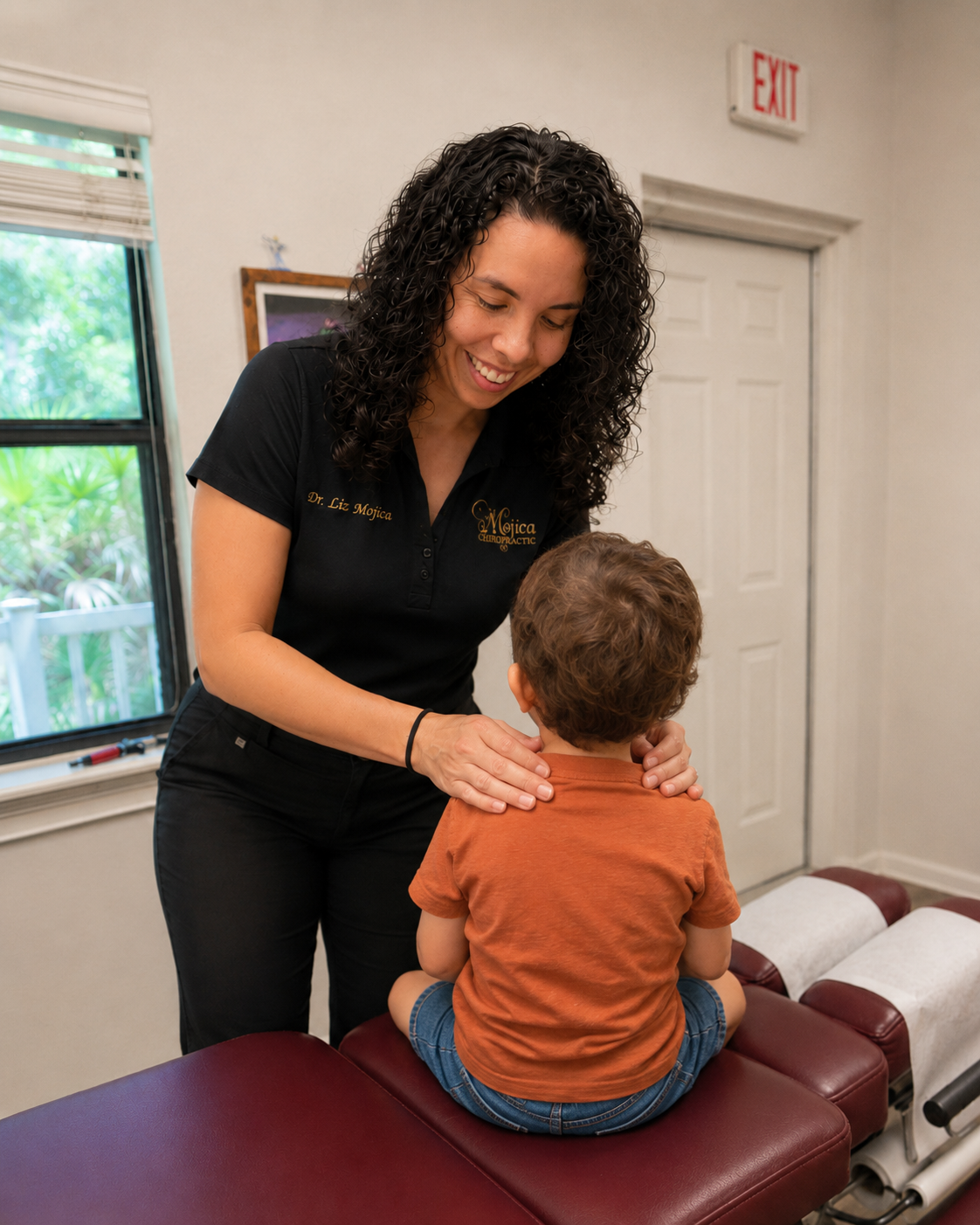
At Mojica Chiropractic Care, Dr. Liz may evaluate:
- • Spinal and joint mobility
- • Posture
- • Body symmetry
- • Balance & Coordination
- • Developmental movement
- • Movement quality
- • Compensation patterns
- • Body awareness
- • Nervous system regulation
When joint restrictions or physical tension patterns are identified, gentle pediatric chiropractic care may be used to support mobility, comfortable movement, and adaptability. Then we observe how the child uses that improved opportunity for movement.
Chiropractic does not treat ADHD, autism, speech delay, or other neurodevelopmental diagnoses.
Our role is to support the physical and nervous-system foundation from which the child moves and functions.
Attention Is More Complex Than Behavior
ADHD is a neurodevelopmental condition involving persistent patterns of inattention and/or hyperactivity and impulsivity that interfere with function or development. Not every active, distracted, or impulsive child has ADHD.
Children can struggle with attention for many reasons, which is why diagnosis requires a broader evaluation rather than a single symptom or test.
For a child with ADHD or attention-related concerns, our developmental lens may look at additional functional patterns such as regulation, sensory seeking, body awareness, coordination, motor planning, movement needs, sleep, developmental history, and the ability to transition between activity levels.
We are not trying to explain ADHD through one physical finding. We are looking at the child as a whole.
Neurodevelopment Can Look Different
Autism is a neurodevelopmental condition associated with differences in social communication and interaction, as well as patterns of behavior, interests, or sensory responses.
Every autistic child is different. Some children communicate verbally. Others communicate differently. Some seek movement. Others avoid particular sensory experiences. Some have significant motor or coordination challenges. Others do not.
Our goal is never to make an autistic child behave or develop like someone else.
Instead, when families seek our support, we want to better understand: How does this child move? How do they experience sensory input? What helps them regulate? What activities are difficult? What movement patterns are present? What strengths can we build upon? What functional goals matter to this child and family?
Chiropractic care does not treat or cure autism. Rooted Pathways is intended to support function, movement, regulation, and participation based on the individual child's needs.
Communication Begins Before Words
Communication development starts long before a child's first spoken word. Babies and children communicate through eye contact, shared attention, facial expressions, sounds, gestures, pointing, imitation, understanding language, words, sentences, and conversation.
Children develop communication skills at different rates. When several communication milestones are delayed, a child is not learning new communication skills, or previously acquired skills are lost, additional evaluation is important.
Speech and language concerns may exist alongside broader differences involving movement, sensory processing, regulation, attention, or development.
Rooted Pathways does not replace speech-language therapy. Instead, these patterns may help us understand the child's broader developmental picture while they receive the appropriate communication support.
This Is Where Rooted Pathways Begins
Sometimes a child has much more going on than restricted joint movement. Parents may see combinations of:
- • Sensory regulation challenges
- • Attention difficulties
- • Coordination concerns
- • Motor-planning challenges
- • Primitive reflex patterns
- • Emotional dysregulation
- • Developmental delays
- • Communication differences
- • Fine- or gross-motor concerns
- • Difficulty participating in daily activities
These are the children for whom we want to look deeper.
Rooted Pathways: A Neurodevelopment Program
Rooted Pathways is designed to evaluate how multiple aspects of development are working together rather than looking at one symptom in isolation.
The program will combine pediatric chiropractic care with specialized pediatric occupational therapy, focusing on developmental movement, primitive reflex assessment and integration, sensory and proprioceptive regulation, balance, coordination, motor planning, body-awareness, and functional developmental goals.
The goal is not to change who your child is. The goal is to identify areas where function may be difficult and create developmentally appropriate experiences that support greater participation, movement, regulation, and independence.
Explore Rooted PathwaysHelping Development Become Function
Children do not develop skills simply to perform them during an evaluation. They develop skills so they can participate in life.
Playing. Dressing. Eating. Writing. Learning. Interacting. Moving through school. Participating with family. Regulating during everyday routines.
Within Rooted Pathways, pediatric occupational therapy will allow us to evaluate how sensory, motor, developmental, and regulation patterns are affecting those everyday activities.
Our pediatric OT will have a particular focus on primitive reflex assessment and integration, sensory processing, proprioceptive regulation, motor planning, coordination, body awareness, developmental movement, and functional participation.
This complements chiropractic's focus on mobility and physical function by helping the child apply movement and regulation within everyday life.
Early Patterns Can Give Us Developmental Information
Primitive reflexes are automatic movement responses that support important functions during early infancy. As voluntary movement develops, these responses typically become less dominant.
When concerns involve coordination, posture, balance, motor planning, body awareness, sensory responses, regulation, or developmental movement, primitive reflex patterns may be included as part of the broader functional assessment.
We do not use a primitive reflex finding to diagnose ADHD, autism, speech delay, or another developmental condition.
Instead, it gives us another opportunity to understand the movement experiences and strategies the child's nervous system may currently be using.
Your Child Is More Than What They Struggle With
A developmental evaluation should not become a list of everything a child cannot do. We also want to know:
- • What are they good at?
- • What do they enjoy?
- • What motivates them?
- • How do they communicate best?
- • What environments help them thrive?
- • What types of movement do they seek?
- • What calms them?
- • What makes participation difficult?
- • What does the family want to make easier?
The goal is to build development around the whole child—not force the child into a predetermined developmental mold.
A Diagnosis Requires More Than Observation
If you have concerns about ADHD, autism, speech or language development, learning, behavior, or your child's overall development, discuss those concerns with the appropriate healthcare or developmental professional.
ADHD diagnosis involves multiple steps because other issues can produce similar attention or behavior patterns. Autism evaluation considers a child's developmental history and behavior. Speech and language concerns may warrant assessment of communication and hearing.
Seek prompt evaluation when a child loses previously acquired language, movement skills, social abilities, or functional abilities.
Mojica Chiropractic Care and Rooted Pathways can complement appropriate diagnostic, educational, and therapeutic care. They do not replace it.
Neurodevelopment Shows Up Across Many Areas
Sensory & Regulation Challenges
Does your child become easily overwhelmed or constantly seek movement and sensory input?
Developmental Milestones & Concerns
Have earlier developmental skills progressed differently than expected?
Crawling & Movement Concerns
Movement history can provide valuable clues about how the child has developed coordination and body awareness.
Support the Foundation First
Mobility is one part of the physical foundation a child uses to interact with the world. Dr. Liz is certified in chiropractic pediatrics and uses gentle, individualized care to evaluate spinal and joint mobility, movement patterns, and nervous system regulation.
For children with more complex developmental needs, that foundation can then connect naturally with the deeper functional work provided through Rooted Pathways.
Explore Pediatric Chiropractic CareYour Child Is More Than a Diagnosis—or a Behavior
Whether your child already has a diagnosis, is being evaluated, or you simply know that certain parts of everyday life are harder for them, we want to understand the child behind the concern.
We can begin by looking at movement, mobility, sensory patterns, regulation, developmental history, and functional needs—and help determine whether pediatric chiropractic care, Rooted Pathways, or another form of support may fit into your child's journey.
Learn More
Is It Behavior—or Is My Child Struggling to Regulate?
Help parents look beneath outward behavior and consider attention, sensory input, communication, fatigue, movement, and regulation.
Read MoreADHD Is More Than Being Hyper
Explain attention, hyperactivity, impulsivity, function, and why a comprehensive perspective matters.
Read MoreSupporting a Neurodivergent Child Without Trying to "Fix" Them
Introduce a strengths-based approach focused on function, participation, regulation, and individualized support.
Read More