
Lower Back Pain Built to Move
When Your Back Starts Changing How You Live
Maybe getting out of the chair takes an extra moment. You hesitate before bending to pick something up. Standing too long becomes uncomfortable. Sitting through the workday leaves your back feeling stiff.
The gym feels different. Sleep becomes harder. Or your lower back seems to settle down—only to flare again a few weeks later.
Lower-back pain is incredibly common, but that does not mean every person's back pain has the same story. At Mojica Chiropractic Care, we look beyond the location of the discomfort to understand: How is your lower back moving, what demands are being placed on it, and how is the rest of your body adapting around it?
Back Pain Changing How You Move? Let's Take a Closer LookLower Back Pain Is Common
But “Common” Does Not Explain Why Your Back Hurts
Low-back pain is one of the most common musculoskeletal concerns worldwide. It can be short-lived, recurring, persistent, mild, sharp, aching, stiff, activity-related, or difficult to clearly explain.
For many people, there is not one single structure or event that fully explains the experience. That does not make the pain imaginary. Pain is real. But understanding pain often requires looking at more than one tissue, one joint, or one image.
Where Is the Lower Back?
The lower back generally refers to the region between the bottom of the rib cage and the pelvis. This area includes lumbar vertebrae, intervertebral discs, spinal joints, muscles, ligaments, nerves, fascia, the sacrum, and connections with the pelvis and hips.
These structures work together every time you sit, stand, walk, bend, lift, turn, carry, exercise, or get out of bed. The lower back is not designed to remain perfectly still. It is designed to participate in movement.
What You May Notice
- Aching across the lower back
- One-sided discomfort
- Stiffness after sitting
- Difficulty standing upright after sitting
- Pain after prolonged standing
- Discomfort bending forward
- Pain returning from a bent position
- Difficulty lifting or tightness after exercise
- Morning stiffness
- Pain after a long workday
- Discomfort while driving
- Difficulty getting comfortable in bed
- Recurrent “flare-ups”
- Symptoms extending into the buttock
Some people can identify exactly when the problem began. Others say: “I didn’t do anything. It just started hurting.” Both experiences deserve evaluation.
Pain Is the Signal
Movement Gives Us More Information
The goal of an evaluation is to understand the person and the movement pattern—not simply chase the painful spot.
Pain Does Not Always Equal Damage
Pain Is More Complex Than a Simple Alarm From One Tissue
Pain is an experience produced by the nervous system in response to information from the body and the situation around it. Sometimes pain closely follows tissue injury. Other times, especially when pain becomes persistent or recurrent, the relationship between symptoms and tissue damage may be less straightforward.
Pain can be influenced by many factors, including tissue irritation, joint and muscular function, previous injury, sensory input, physical activity, sleep, stress, repetition, recovery, movement confidence, expectations, and prior experiences. This does NOT mean pain is “all in your head.” It means pain is a brain-body experience.
Your Back Is Strong
Avoid the Fragility Story
Adults with back pain are often told things like: “Your back is out,” “Your spine is misaligned,” or “You should never bend like that again.” That kind of language can make normal movement feel dangerous.
The spine is a strong, adaptable structure. It is designed to bend, extend, rotate, transfer load, absorb force, and support movement. The goal of care should not be to make someone afraid of their back. It should be to understand the presentation and help support confident, appropriate movement.
Movement Is a Nervous-System Process
When you bend to pick something up, your nervous system coordinates much more than the lower back. It receives information from spinal joints, hips, pelvis, feet, muscles, proprioceptive receptors, vision, and balance systems.
The brain uses that information to determine where your body is, how far you are moving, how much force is required, which muscles should participate, how to maintain balance, and what adjustment is needed next. Movement is therefore both a mechanical and neurological process.
Your Lower Back Does Not Work Alone
Bending, walking, lifting, and standing require movement and coordination across multiple regions—not just the lower back.
Compensation Is Not the Enemy
Your Body Is Trying to Solve a Problem
When something is uncomfortable, people naturally move differently. You may lean toward one side, avoid bending, shorten your stride, turn with your whole body, use your arms to stand, shift more weight onto one leg, stop exercising, or brace before moving.
Those strategies may be useful in the short term. Your nervous system is trying to protect you and keep you moving. The question is whether a protective strategy continues long after it is useful and begins limiting your movement options. Our goal is not to criticize compensation. It is to understand it.
This is a simplified educational model. Pain and recovery are individual and do not follow one universal pathway.
Mobility Gives You Options
Mobility means having useful movement available when your body needs it. That may involve lumbar movement, pelvic movement, hip movement, thoracic movement, comfortable rotation, or weight shifting.
More movement is not always better. The goal is: appropriate movement + control + adaptability. When your body has more comfortable movement options, it may not need to rely on the same strategy every time you bend, lift, walk, or stand.
Why Does Sitting Make My Back Hurt?
Sitting itself is not inherently bad. But staying in any one position for a long time can become uncomfortable. Instead of chasing one “perfect posture,” encourage: movement variety.
The best position is often simply the next comfortable position. Change positions periodically, stand and move when practical, and alternate tasks when possible.
What About Bending?
Adults with back pain may become afraid of bending. But the spine is designed to move. Some people may temporarily need to modify how much, how often, or how heavily they bend while symptoms are irritated.
As appropriate, returning to comfortable movement can help restore confidence and function. The goal should be gradual capacity—not lifelong avoidance.
Lifting & Physical Demands
There is no single lifting technique that guarantees a person will never experience back pain. What matters includes load, frequency, fatigue, distance from the body, repetition, available mobility, strength, recovery, and individual tolerance.
Someone lifting once at the gym has a different demand than someone repeatedly lifting children, boxes, equipment, groceries, patients, or tools throughout an entire workday. We evaluate the person—not simply whether a lift looked “perfect.”
Low Back Pain vs. Sciatica
Lower-back pain primarily describes symptoms in the lumbar region. Sciatica refers to symptoms associated with irritation or involvement of the sciatic nerve or contributing nerve roots, such as pain traveling through the buttock and leg, burning, tingling, or numbness.
Explore Sciatica & Radiating Leg Pain“Do I Need an X-Ray or MRI?”
Not every episode of lower-back pain requires imaging. Imaging may be appropriate when history or examination suggests significant trauma, neurological changes, fracture concern, infection, cancer, or other specific pathology.
For uncomplicated nonspecific acute low-back pain without concerning findings, routine imaging is generally not automatically necessary. Imaging is a tool—and tools are most useful when there is a clinical reason to use them.
What We Look At
Dr. Liz may evaluate:
- Lumbar, pelvic, sacral & hip mobility
- Thoracic mobility & right-to-left differences
- Postural strategies & balance
- Standing, walking, bending & rotation
- Movement transitions
- Neurological & orthopedic findings when appropriate
- Physical demands, exercise habits & work environment
- Previous injuries & symptom pattern
- Nervous-system regulation
The purpose is to build a clearer picture of: what you are feeling + how you are moving + what your body is being asked to do.
How Chiropractic Care Fits
Support Movement, Mobility & Function
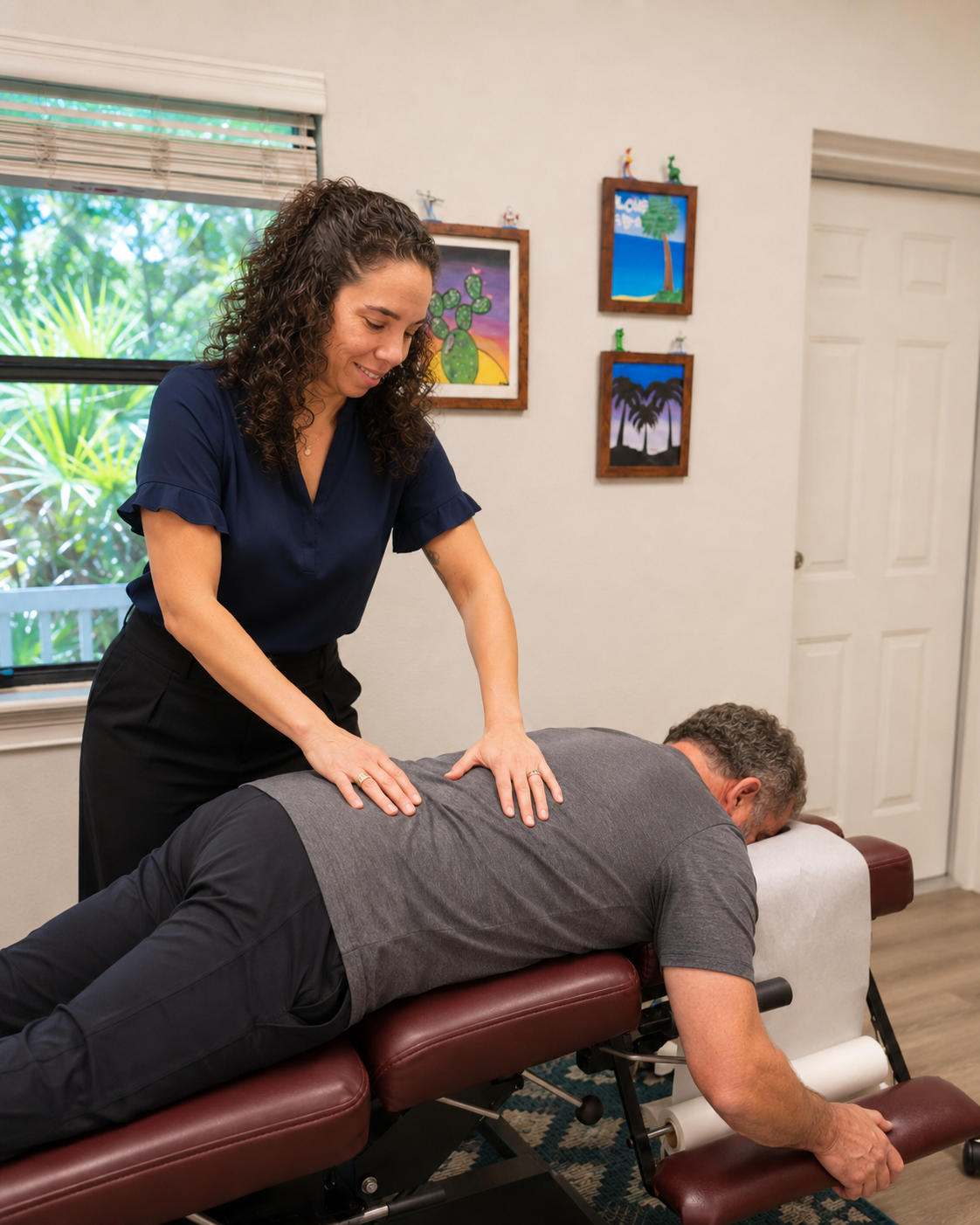
Chiropractic care at Mojica Chiropractic Care is individualized. When areas of restricted spinal or joint mobility are identified, Dr. Liz may use chiropractic adjustments and other appropriate approaches to support joint mobility, comfortable movement, movement options, body awareness, postural adaptability, physical function, and nervous-system input.
The goal is not to create a perfectly aligned spine. The goal is to support the person's ability to move, adapt, and participate in the activities that matter to them.
Movement Still Matters
When the back is irritated, temporary modification may be appropriate. But prolonged inactivity can also make returning to normal activity more difficult.
When appropriate, encourage adults to remain engaged in tolerable movement and gradually return to walking, work, exercise, household activities, recreation, and family activities based on their individual presentation.
Recurrent Back Pain
“Why Does This Keep Coming Back?”
A recurring episode does not automatically mean something is becoming progressively damaged. Recurrence may encourage us to look more closely at movement capacity, physical workload, recovery, exercise, sleep, repetitive tasks, mobility, strength, previous protective patterns, and confidence with movement.
The question shifts from: “How do I make this pain disappear today?” to: “How do I build a body that is better prepared for the demands of my life?”
Function Before Perfection
What Do You Want to Get Back To?
For one person, success may mean sitting through work without constantly thinking about the back. For someone else: Picking up their child. Gardening. Going to the gym. Playing golf. Traveling. Sleeping comfortably. Walking the dog.
The goal is not a textbook-perfect spine. It is meaningful function.
When Lower Back Pain Needs Further Evaluation
Most back pain is not an emergency—but some symptoms matter. Seek prompt medical evaluation when back pain occurs with concerning features such as:
- • New bowel or bladder control problems
- • Numbness around the groin, genitals, or saddle region
- • Significant or progressive leg weakness
- • Major trauma
- • Fever or signs of systemic illness
- • History or symptoms that raise concern for infection
- • Known cancer with new unexplained back pain
- • Unexplained significant weight loss
- • Severe pain with significant neurological changes
You May Also Be Noticing
Sciatica & Radiating Leg Pain
Does pain travel into your buttock or leg, or include burning, tingling or numbness?
Learn MoreAdult Chiropractic Care
Adult chiropractic care considers how your spine, pelvis, hips, movement, and physical demands interact.
Learn MoreWellness Connection
For some adults, the initial goal is getting through an uncomfortable episode. Later, the conversation may shift toward maintaining movement, supporting mobility, staying active, managing physical demands, and continuing healthy movement habits.
Explore Wellness CareKeep Doing What Matters to You
Your back is more than the spot that hurts. Lower-back pain can change how you sit, work, exercise, sleep, lift, and move through daily life. Understanding the symptom is important. Understanding the movement around it gives us even more information.