
Primitive Reflexes & Development
Early movement patterns are part of how babies begin interacting with their bodies and the world around them. Understanding primitive reflexes can help parents see development as a connected process—not simply a checklist of milestones.
How Neurodevelopment WorksWhat Are Primitive Reflexes?
Primitive reflexes are automatic movement responses that are present during infancy. They are sometimes called “primitive” because they appear very early in development, before a child has developed mature voluntary control over movement.
These reflexes help an infant respond to important sensory experiences such as touch, position changes, head movement, gravity, and pressure.
As the brain and nervous system mature—and as babies gain more movement experience—these early reflex patterns generally become less dominant and are gradually replaced by more intentional, coordinated movement. That transition is part of normal sensory-motor development.
Primitive reflexes are not simply movements babies “grow out of.” They are part of the early sensory-motor experiences through which the developing nervous system learns about the body and environment.
Why Do Primitive Reflexes Matter?
Early development involves constant communication between the body and nervous system.
A baby turns their head.
Their body shifts.
Their arms and legs respond.
Sensory receptors detect the movement.
Information travels back to the nervous system.
The nervous system processes that experience and adapts.
This cycle happens thousands of times as babies move, explore, and interact with their surroundings. Primitive reflexes are part of that early developmental process. Over time, children begin to gain more voluntary control over posture, balance, reaching, rolling, sitting, crawling, standing, and walking.
Development is not simply the nervous system issuing commands to the body.
Movement also gives information back to the nervous system.
That is why movement experience matters so much during early childhood.
Some Primitive Reflexes Parents May Hear About
A visual overview of early automatic movement patterns and how they express in infancy.
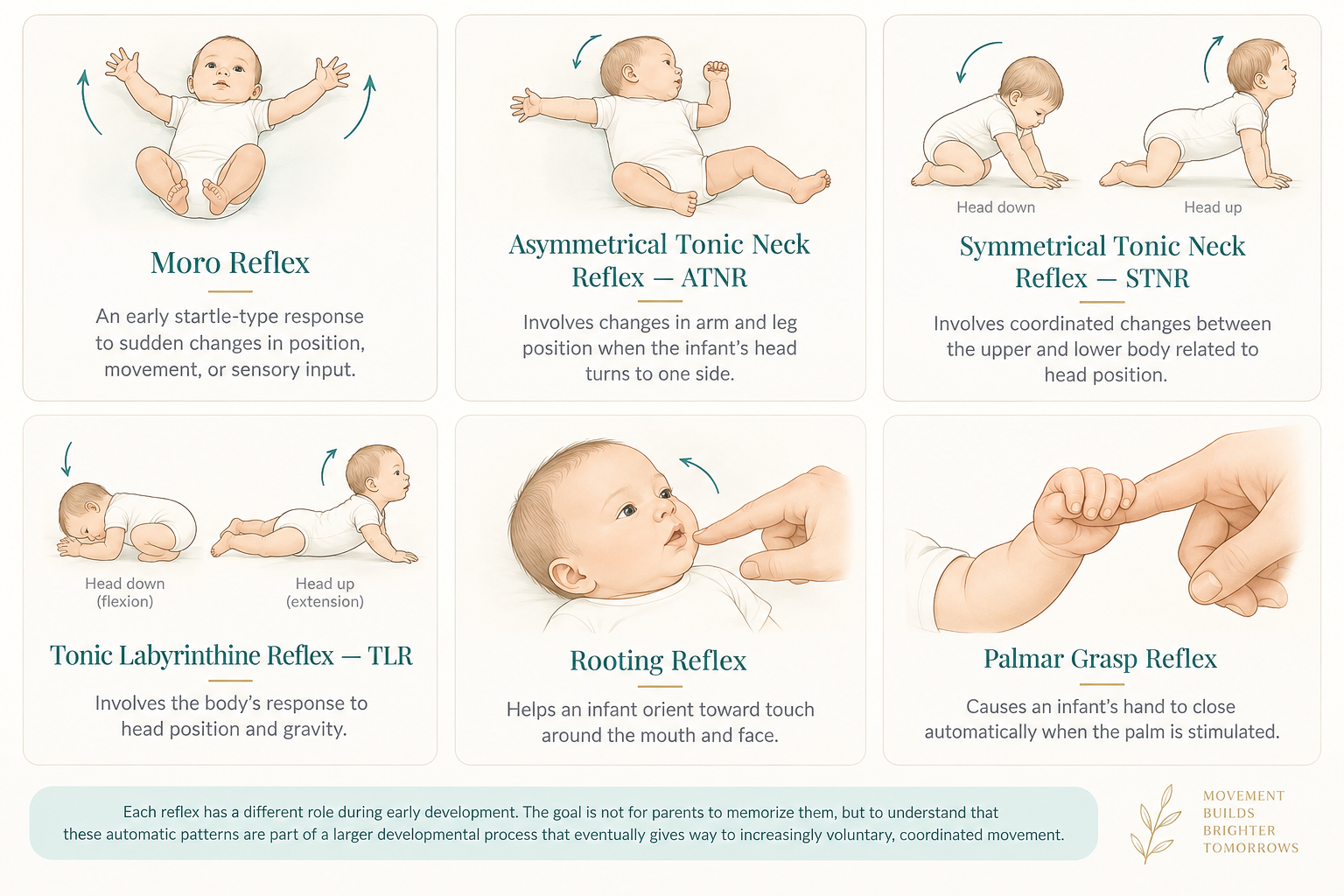
What Does “Retained Primitive Reflex” Mean?
Parents may hear the term retained primitive reflex when researching development. This generally refers to a primitive reflex response that remains more easily triggered or influential beyond the developmental period when more mature movement patterns would normally begin taking over.
This does not automatically mean something is wrong with a child. Development varies from child to child, and no single reflex should be interpreted in isolation. However, persistent primitive reflex activity can sometimes be observed alongside challenges involving areas such as posture, balance, coordination, body awareness, motor planning, sensory regulation, or certain movement patterns.
The important question is not simply:
“Does my child have a retained reflex?”
A more useful question is:
“How is my child moving, adapting, coordinating, and responding to sensory information as a whole?”
What Might Parents Notice?
Parents rarely come into our office saying: “My child has an ATNR.” They are much more likely to notice everyday patterns.
A parent might wonder why their child seems unusually clumsy, struggles with balance, avoids certain movements, has difficulty coordinating both sides of the body, becomes overwhelmed by particular sensory experiences, or moves differently from other children their age.
Some children may seek a great deal of movement. Others may avoid it. Some may struggle with activities requiring balance, coordination, posture, or body awareness.
None of these observations alone proves that a primitive reflex is responsible. They are simply pieces of information that can help us look more carefully at the child's overall development.
Development Happens Through Movement and Experience
One of the most important things parents can understand about childhood development is that the nervous system develops through experience. Children learn by doing.
Each experience provides new sensory information. The nervous system continually receives that information, responds to it, and adapts. This is one reason we value natural movement experiences so highly.
Floor play, tummy time, crawling, climbing, carrying, pushing, pulling, swinging, balancing, and exploring different positions all provide opportunities for the developing nervous system to experience the body in different ways.
There is no single exercise that creates healthy development.
It is the variety and repetition of meaningful movement experiences that matter.
Development Is Not a Perfectly Straight Line
That sequence can be useful for understanding how movement skills often build over time. But children are not machines following a program. Development can vary. Children may spend longer in one stage than another. Some may find alternative ways of moving. Others may need additional support with particular skills.
And one skipped milestone does not automatically predict a future problem. What matters is the broader developmental picture:
- ●How is the child moving?
- ●How are they using both sides of their body?
- ●How are they responding to gravity and balance?
- ●How are they coordinating movement?
- ●How are they adapting to new physical challenges?
Looking at development this way gives us much more useful information than focusing on one isolated milestone or reflex.
Where Pediatric Chiropractic Fits
At Mojica Chiropractic Care, we view movement, joint mobility, proprioceptive input, body awareness, and nervous-system function as connected pieces of the developmental picture.
The joints and muscles of the spine contain sensory receptors that provide continuous information about movement and body position. Pediatric chiropractic care focuses on healthy joint mobility and neuromusculoskeletal function using gentle, age-appropriate care.
Supporting comfortable, efficient movement can help provide a stronger physical foundation for the ways children move, explore, play, and interact with their environment.
We do not describe chiropractic adjustments as “integrating primitive reflexes.” Primitive reflex integration is a broader developmental process involving the nervous system, movement, sensory experiences, maturation, and repeated practice.
Chiropractic can instead be one component of a whole-child approach that supports the movement and neuromusculoskeletal foundation involved in that process.
Our focus is supporting the movement and neuromusculoskeletal foundation through which children experience their bodies and interact with the world.
Looking at the Whole Child
Primitive reflexes should never be considered in isolation. A child's development may involve:
Depending on the child's needs, support may also involve pediatric providers, occupational therapists, physical therapists, speech-language pathologists, developmental specialists, educators, mental-health professionals, and other members of the child's healthcare team.
Different professionals may address different pieces of the developmental picture. Our role is to focus on the movement, joint mobility, neuromusculoskeletal function, and nervous-system piece while helping families think about development more broadly.
Primitive Reflexes Are One Piece of Neurodevelopment
Primitive reflexes are fascinating because they show just how closely movement and nervous-system development are connected from the very beginning of life. But they are only one piece of a much larger developmental picture.
Movement, sensory input, body awareness, balance, coordination, regulation, environment, experience, and relationships all interact as children grow. Understanding those connections can help parents move beyond simply asking:
“Is my child meeting the milestone?”
“How is my child's nervous system learning through movement and experience?”
Want to Understand the Bigger Picture?
Primitive reflexes are only one part of neurodevelopment. If you would like to understand how movement, sensory input, regulation, neuroplasticity, and childhood development fit together, start with our foundational guide.
Mojica Chiropractic Care provides gentle pediatric chiropractic care for families in Winter Springs, Oviedo, and surrounding Central Florida communities.