
Chiropractic Care for Active Kids & Young Athletes
Baseball. Volleyball. Dance. Gymnastics. Soccer. Basketball. Football. Cheer. Martial arts. Running.
Whatever your child loves to do, an active growing body is constantly being challenged to move, balance, stabilize, accelerate, decelerate, rotate, jump, land, throw, reach, and recover. Then add growth spurts, school, backpacks, sitting, technology, practices, tournaments, and everyday life.
Sometimes the movement strategy that worked six months ago no longer works as efficiently in the body your child has today. That is why we do not look only at where it hurts. We look at:
How is your child moving?
A Growing Athlete Is Not Just a Small Adult
Children and adolescents are constantly changing. Bones grow. Muscles adapt. Coordination becomes more sophisticated. Balance changes. Strength develops. Motor patterns become increasingly complex.
During periods of rapid growth, a child may suddenly look:
- • Less coordinated
- • Tighter
- • More awkward
- • Less flexible
- • Different in their running pattern
- • Different in their posture
- • Less balanced than before
Their nervous system is continually learning how to control a body whose size and proportions are changing. Sports add another layer by asking children to perform the same movements repeatedly and often at increasing intensity.
The goal is not simply to make a growing athlete stronger. It is to make sure they have a body that can move well enough to use that strength efficiently.
Sometimes the First Sign Is Not Pain
Parents may notice:
- ✓ One shoulder sitting higher or one hip appearing different during movement
- ✓ A child always rotating toward the same side
- ✓ Difficulty touching their toes or squatting comfortably
- ✓ Stiffness after practices or games
- ✓ Recurrent muscle tightness or difficulty recovering
- ✓ Changes in running or throwing mechanics
- ✓ Loss of flexibility during a growth spurt
- ✓ Balance or coordination challenges
- ✓ One-sided movement patterns or jumping/landing issues
- ✓ Complaints of back, hip, knee, shoulder, or neck discomfort
- ✓ A child who performs differently when fatigued
- ✓ Repeated small complaints that seem to keep returning
Pain is important. But movement changes can sometimes become visible before pain becomes the main complaint.
Movement Quality Matters
A basketball player may jump and land hundreds of times. A volleyball player repeatedly accelerates, drops, changes direction, and reaches. A baseball player rotates and throws through the same pattern again and again. A gymnast repeatedly loads the shoulders, spine, hips, and wrists. A dancer demands mobility, balance, control, and repetition.
Sports do not create movement from scratch. They amplify the movement strategies a child already uses.
If a child moves efficiently, repetition gives them more practice with that strategy. If a child repeatedly compensates around limited mobility or poor control, they may also practice that compensation hundreds or thousands of times.
That is why we believe: How your child moves matters—not only how much they train.
Mobility Before Complexity
Every sport requires a combination of joint mobility, stability, strength, coordination, balance, timing, body awareness, and motor planning.
Before asking a child to repeatedly strengthen a movement, it is helpful to understand whether they have access to the motion the activity requires. For example, limited mobility in one region may lead the body to find movement somewhere else. That is compensation.
Compensation is not automatically bad. The human body is incredibly adaptable. But when the same compensatory strategy is repeated under increasing load, speed, and fatigue, it may become relevant to how efficiently an athlete moves.
At Mojica Chiropractic Care, we begin by asking: Does this growing body have the mobility needed for what we are asking it to do?
Movement Is Also Neurological
Athletic development is not only about muscles. Every time a child catches a ball, changes direction, balances, jumps, lands, rotates, or reacts to another player, the nervous system is processing enormous amounts of information.
The brain must know where the body is, where the joints are positioned, how quickly the body is moving, how much force is being produced, where other people and objects are in space, and what movement needs to happen next.
Proprioception & Body Awareness
Proprioception is the sensory information that helps the nervous system understand where the body and joints are positioned. Athletes depend on this continuously to land after jumping, change direction, catch themselves when they lose balance, control force, position an arm for throwing, and adjust quickly to another player's movement.
Sports provide enormous amounts of proprioceptive input. Over time, these experiences help children develop more sophisticated body awareness and movement control.
What We Look At
A pediatric sports chiropractic assessment should involve more than asking where something hurts. Depending on the athlete, sport, age, and concern, Dr. Liz may look at:
- • Spinal and pelvic mobility
- • Hip and shoulder mobility
- • Neck and joint restrictions
- • Posture and body symmetry
- • Movement compensation
- • Squatting and balance
- • Coordination and weight shifting
- • Rotation and right-to-left differences
- • Sport-specific movement patterns
- • Nervous system regulation
- • Overall movement quality
The goal is to better understand the physical foundation the athlete is using every time they practice or compete.
How Chiropractic Care Fits
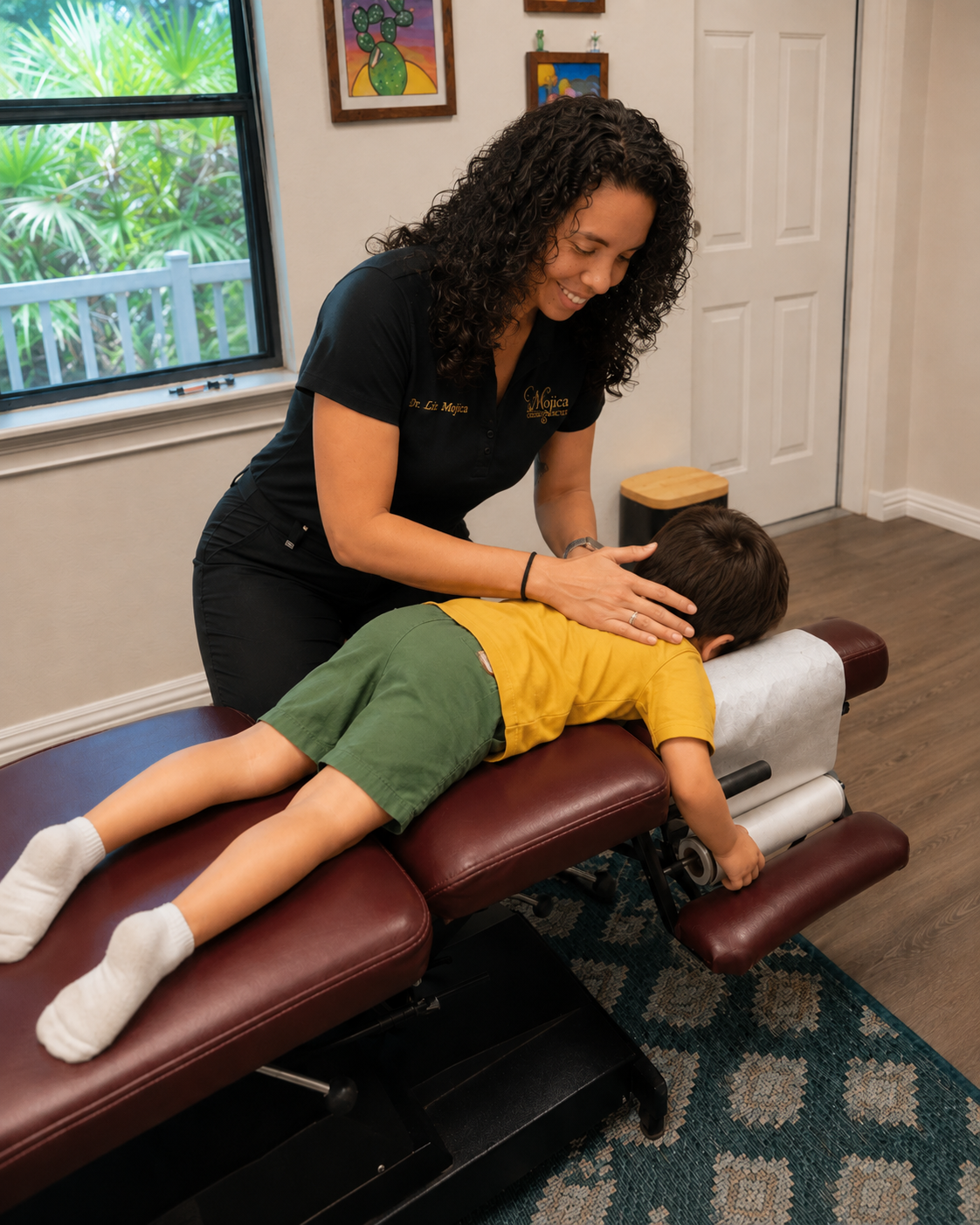
Dr. Liz uses gentle, specific chiropractic care to identify and address restrictions in spinal and joint mobility. For active children, care may focus on supporting joint mobility, comfortable movement, symmetry, body awareness, adaptability, posture, movement efficiency, and nervous system regulation.
We are not trying to make every athlete perfectly symmetrical. Sports themselves can create different demands on different sides of the body. A pitcher throws with one arm. A volleyball player may repeatedly approach from a preferred direction. A soccer player may favor one foot.
The question is whether the child's movement strategy allows them to meet those demands comfortably and efficiently.
Performance Is More Than Strength
Strength training can be extremely valuable for young athletes when it is age appropriate and properly supervised. But strength is only one component of performance. An athlete also needs mobility, stability, coordination, balance, motor control, recovery, appropriate training load, sleep, and nutrition.
This is why simply strengthening the area that feels weak may not answer the entire question. First understand the movement. Then build strength and skill on top of a better movement foundation.
Growth Spurts Can Change Everything
Children sometimes appear to become less coordinated during rapid periods of growth. Their center of mass changes. Levers become longer. Muscles and soft tissues adapt to changing bone length.
Movement that once felt automatic may temporarily require greater adjustment. This is one reason we continue reassessing young athletes rather than assuming that a movement pattern observed one year ago still represents the child today. A developing athlete is never static.
Recovery Is Part of Training
Young athletes increasingly participate in year-round sports, travel teams, private training, school teams, multiple leagues, strength programs, camps, and tournaments. The body needs time to adapt to training.
Repetitive loading without adequate recovery can contribute to overuse problems in young athletes. Recovery should therefore be viewed as part of athletic development—not time lost from it.
Pain Is Information
There is a difference between normal effort during training and persistent pain. Children should not learn that being a committed athlete means ignoring recurring pain.
Pay attention when a child repeatedly complains about the same area, begins changing how they move, develops swelling, starts limping, or has pain that worsens with activity. The goal should not be to get a child back onto the field as quickly as possible. The goal should be to understand why they are struggling to move comfortably.
After an Injury
Some sports concerns clearly require medical or orthopedic evaluation. Seek appropriate evaluation for concerns such as significant trauma, suspected fracture, joint deformity, significant swelling, inability to bear weight, severe or rapidly worsening pain, significant weakness, numbness, or loss of normal limb function.
Once serious injury has been ruled out or appropriately managed, chiropractic care may play a role in supporting mobility and movement during the athlete's return to normal activity.
A Special Note About Concussion
A concussion is a brain injury. A child with a suspected concussion should be removed from sports participation and evaluated appropriately. Do not use chiropractic care as a substitute for concussion evaluation or clearance.
Return to sports should follow the recommendations of the healthcare professional managing the child's concussion.
What About Preventive Care?
Many families choose pediatric chiropractic care because their child is active—not because their child is injured. A movement-focused visit can provide an opportunity to look at mobility, symmetry, posture, coordination, the physical demands of the sport, and repetitive movement patterns.
The philosophy is simple: Do not wait until the body is yelling before you start listening to how it moves.
When There May Be More to the Movement Story
Sometimes the concern is not primarily pain or mobility. Parents may notice an athlete who struggles significantly with coordination, has difficulty learning movement sequences, has poor body awareness, falls frequently, cannot easily coordinate both sides, or has developmental movement concerns outside sports.
When those patterns extend beyond sport performance, a deeper developmental assessment may be useful. This creates a natural connection to Rooted Pathways: A Neurodevelopment Program, which looks more deeply at developmental movement, coordination, balance, body awareness, motor planning, and sensory regulation.
Explore Rooted PathwaysGrowing Bodies Tell Us Their Story in Different Ways
Scoliosis & Posture Concerns
Noticing uneven shoulders, postural changes, or asymmetry as your child grows?
Learn MoreDevelopmental Milestones
Does coordination or movement difficulty seem to be part of a larger developmental pattern?
Learn MoreSensory & Regulation
Does your child seek constant movement or struggle with body awareness and regulation?
Learn MoreCare That Grows With Your Child
The physical demands placed on a 4-year-old are very different from those placed on a 14-year-old athlete. Dr. Liz is certified in chiropractic pediatrics and adapts care according to the child's age, size, development, activity level, sport, movement patterns, and current needs.
Explore Pediatric Chiropractic CareLearn More
Does My Young Athlete Need Chiropractic Care If Nothing Hurts?
Explain the difference between a pain-focused approach and evaluating mobility and movement in an active growing child.
Growth Spurts & Sports: Why Does My Child Look Less Coordinated?
Explain how rapid physical growth can temporarily change movement demands, flexibility, balance, and coordination.
Pain or Normal Soreness? What Young Athletes Should Not Ignore
Help families recognize when recurring pain, swelling, limping, or movement changes deserve evaluation.
Help Their Body Keep Up With What They Love to Do
Growing athletes ask a lot from their bodies. Rather than waiting until discomfort becomes the only reason to pay attention, we can look at how your child's body moves, adapts, and responds to the demands of their sport.