
ADHD, Attention & Regulation
Attention Is About More Than Sitting Still
A child’s nervous system is constantly deciding what information matters, what can be ignored, how the body needs to respond, and when it is time to shift from one level of activity to another.
For some children, that process requires much more effort. They may move constantly, struggle to settle into one activity, become distracted by everything around them, seek physical input, or seem to go from “zero to one hundred” very quickly.
At Mojica Chiropractic Care, we look beyond whether a child can simply sit still. We look at the body beneath the attention challenge—including movement, joint function, proprioceptive input, posture, neuromusculoskeletal patterns, and how the nervous system is receiving information from the body throughout the day.
Before a Child Can Focus, the Nervous System Has Work to Do
Paying attention looks simple from the outside.
But neurologically, the body is doing much more. The nervous system is continuously:
For a child, this process is happening while they are sitting in class, doing homework, playing a sport, listening to directions, transitioning between activities, or trying to fall asleep.
Attention does not happen separately from the rest of the body. It occurs within a nervous system that is constantly sensing, moving, responding, and adapting.
“Sometimes what looks like difficulty paying attention is happening in a body that is working very hard to organize everything it is receiving.”
Movement May Be Giving the Nervous System Information
Parents often tell us:
- ●“They never stop moving.”
- ●“They cannot sit in the chair.”
- ●“They are always climbing something.”
- ●“They crash into the couch.”
- ●“They fidget through homework.”
- ●“They focus better when they are moving.”
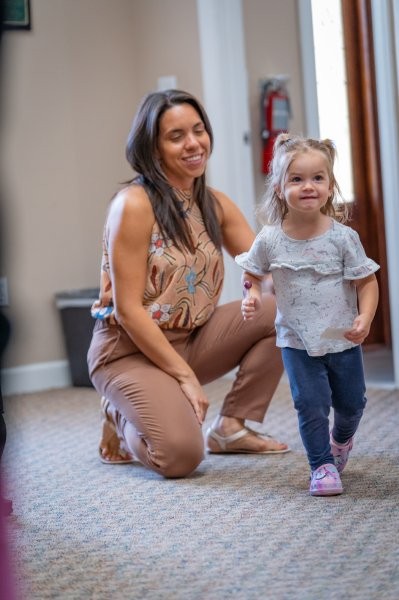
Movement is not simply wasted energy. Every time the body moves, muscles contract and joints change position. Sensory receptors within the muscles, joints, skin, and surrounding tissues generate information that travels toward the central nervous system.
That information helps the brain understand what the body is doing and where it is in space. For some children, movement may provide a type of sensory input they actively seek.
This does not mean every child who moves frequently has ADHD. And it does not mean movement-seeking behavior has one simple cause.
But it does remind us that movement is part of the neurological picture—not separate from it.
How Does Your Child Know Where Their Body Is?
Proprioception is the sensory system that provides information about body position and movement. It helps a child know:
- ●Where are my arms and legs?
- ●How much force am I using?
- ●How far do I need to reach?
- ●How should I adjust my posture?
- ●How much pressure am I applying?
- ●Where is my body relative to the environment around me?
Children receive proprioceptive information every time they push, pull, climb, jump, run, balance, carry, stretch, change position, or move a joint.
This ongoing flow of information contributes to body awareness, coordination, motor control, and the child’s ability to interact efficiently with their environment.
“A child does not experience attention with only their brain. They experience it through a brain and body working together.”
Attention Can Require More Physical Effort Than We Realize
Imagine trying to listen to a conversation while constantly adjusting an uncomfortable chair. Or trying to read while your body is telling you that you need to move. Or trying to follow directions while multiple sensations are competing for your attention.
Children may not have the words to explain what their bodies are experiencing. Instead, parents may notice:
These observations are not diagnostic of ADHD. They are information about how the child is using and experiencing their body. And that information matters to us during a pediatric chiropractic evaluation.
Movement Creates Neurological Input
A chiropractic adjustment is a controlled mechanical input applied to a joint. From a mechanical perspective, we are interested in healthy joint mobility and function.
But joints are also rich sources of sensory information. Movement stimulates receptors within joints, muscles, skin, and surrounding tissues. That sensory—or afferent—information travels into the nervous system where it becomes part of the ongoing information being processed about:
That is the neurological connection behind pediatric chiropractic care. At Mojica Chiropractic Care, an adjustment is not simply about whether something hurts. We are asking:
- ●How is this child's body moving?
- ●Where is movement restricted?
- ●Where is the child compensating?
- ●How much physical effort is required for everyday movement?
- ●What type of sensory information is being generated through their movement?
- ●And how can we support healthier movement and proprioceptive input?
“Pediatric chiropractic supports one of the nervous system’s most constant sources of information: the body.”

Regulation Means Being Able to Shift and Adapt
A regulated nervous system does not mean a child is quiet all the time. Children need different levels of activity for different situations.
Running across a playground requires one state. Listening to a story requires another. Falling asleep requires another. Moving from one activity to the next requires the nervous system to continually adjust.
Regulation involves the ability to receive information, organize an appropriate response, and shift as demands change. Those demands may involve:
Because the musculoskeletal system continuously provides sensory information to the nervous system, we consider healthy movement, joint function, and proprioceptive input part of the physical foundation involved in adaptability.
Chiropractic adjustments provide mechanical and sensory input into that system. By supporting healthy joint mobility, movement, and proprioceptive input, pediatric chiropractic may support the physical and sensorimotor foundation involved in responding and adapting to changing demands.
Can We Measure More Than Behavior?
Yes—and this is an important part of our approach. When appropriate for the child’s age and ability to participate, Mojica Chiropractic Care uses INSiGHT™ scanning technology to gather objective physiologic information.
neuroPULSE / HRV
Adaptability
Heart-rate variability, or HRV, examines variations in the timing between heartbeats. We use this information as one objective piece of the larger picture when considering autonomic patterns and how the body is responding to changing demands.
neuroCORE / Surface EMG
Muscle Activity
Surface EMG measures patterns of electrical activity in the muscles along the spine. It can help us identify areas where muscular activity appears increased, asymmetric, or compensatory.
These findings are considered alongside the child’s history, movement, posture, examination, and chiropractic findings.
Explore Our INSiGHT™ ScansA Child Who Is Struggling Is Not Necessarily Choosing to Struggle
“Pay attention.” “Sit still.” “Stop fidgeting.” “Just focus.”
Parents of children with attention challenges may hear these phrases constantly. But behavior is only the part we can see.
Underneath it is a nervous system receiving enormous amounts of information and continually trying to determine what deserves attention and how the body should respond.
That does not mean every behavior has a neurological explanation or that expectations do not matter. It means we believe understanding the child’s body provides more useful information than simply asking them to try harder.
At Mojica Chiropractic Care, we want to understand the child before we make assumptions about the behavior.
Looking Beyond the Label
When Dr. Liz evaluates a child with attention or regulation concerns, we want to understand how the child’s body is supporting the demands placed on their nervous system.
- ●How is the child's body moving?
- ●Where is movement restricted?
- ●Are there areas of compensation?
- ●How is posture being organized?
- ●How well are both sides of the body working together?
- ●Does movement appear easy or require additional effort?
- ●Are there patterns of physical tension?
- ●What does the neuromusculoskeletal examination show?
- ●What objective patterns do the INSiGHT scans show?
- ●How can chiropractic care support healthier movement and proprioceptive input for this child?
“Together, these findings help us understand how your child’s body is moving, responding, and adapting—so chiropractic care can be tailored to their individual needs.”
Movement Is Not the Enemy of Attention
Children learn through movement. Movement provides sensory input. Movement challenges balance and coordination. Movement builds body awareness. Movement gives the nervous system repeated opportunities to receive information, organize a response, and try again.
For children with attention and regulation challenges, movement should not automatically be viewed as something that needs to be eliminated. Sometimes we need to understand why the child’s body is seeking it.
Pediatric chiropractic is not an exercise program and does not replace appropriate physical activity. Our role is to support the joint mobility and neuromusculoskeletal foundation that allows the child to move through those experiences.
Learn more about how movement helps shape a child’s developing nervous systemCould Early Movement Patterns Still Matter?
Primitive reflexes are automatic movement patterns present early in development. As voluntary motor control becomes more mature, these early patterns normally become less dominant.
When primitive reflex patterns remain influential, some movements or postural tasks may require additional compensation or effort.
Primitive reflexes do not cause ADHD. A retained primitive reflex does not diagnose ADHD. And chiropractic adjustments are not described as “integrating” primitive reflexes.
Instead, primitive reflex findings may be considered alongside posture, coordination, balance, motor patterns, body awareness, and the child’s broader developmental history—while chiropractic continues to focus on joint mobility, movement, proprioceptive input, and neuromusculoskeletal function.
Explore Primitive Reflexes & DevelopmentChiropractic Is Not an Either/Or Decision
Some children with ADHD use medication. Others do not. Medication decisions belong between families and the child’s prescribing healthcare provider.
Pediatric chiropractic addresses a different part of the picture: the child’s neuromusculoskeletal system, joint function, movement, proprioceptive input, and physical adaptability.
Families do not need to choose between appropriate medical care and chiropractic care.
We Meet the Child in Front of Us
A child who needs to move should not have to suddenly become perfectly still just because they walked into a chiropractic office.
Some children explore the room. Some ask twenty questions. Some need movement breaks. Some want to watch everything first. Some are ready immediately. We adjust the pace, positioning, communication, and expectations whenever possible while still completing an appropriate clinical evaluation.
Understanding Your Child
- Developmental and health history
- Parent concerns
- Attention and regulation patterns the family has observed
- Movement and postural observations
- Chiropractic examination
- Age- and developmentally-appropriate INSiGHT scans when tolerated
Understanding What We Found
- Dr. Liz reviews the examination findings
- Movement and postural observations
- Relevant neuromusculoskeletal findings
- INSiGHT scan results
- How those findings relate to chiropractic care
- Whether care is appropriate
If the family chooses to begin care, the first adjustment occurs at the end of Day 2.
Frequently Asked Questions
Sometimes Supporting Attention Starts by Looking at the Body Differently
Your child’s nervous system is constantly receiving information through a body that moves, senses, responds, and adapts all day long.
At Mojica Chiropractic Care, we look beyond whether a child can simply sit still. We want to understand how their body is moving, what information it is providing, and where pediatric chiropractic may help strengthen the physical foundation they rely on every day.