How Neurodevelopment Works
Development Is Built Through Experience
A child does not wake up one day knowing how to crawl, balance, communicate, regulate emotions, catch a ball, focus in a classroom, or coordinate a complex movement. Development happens gradually.
The brain and body are constantly communicating as children move, touch, listen, look, balance, play, explore, interact, practice, and adapt. Every experience gives the developing nervous system information. Over time, repeated experiences help children build increasingly complex abilities.
This is neurodevelopment. At Rooted Pathways, we look beyond individual symptoms and ask a bigger question: How is this child's brain and body learning to work together?
Explore Rooted PathwaysWhat Is Neurodevelopment?
Building the Systems Children Use Every Day
Neurodevelopment is the ongoing development of the brain and nervous system and the abilities that emerge as those systems mature and interact with experience.
It influences functions such as movement, balance, coordination, body awareness, communication, learning, attention, sensory processing, motor planning, emotional regulation, social interaction, and independence.
These abilities do not develop in isolation. A child uses balance while playing. Movement while exploring. Attention while communicating. Sensory information while learning. Body awareness while dressing. Regulation while participating at school. Development is an interconnected process.
The Developing Brain Changes Through Experience
Neuroplasticity
The nervous system has the ability to change in response to experience. This is called neuroplasticity.
During childhood, developing neural systems are especially responsive to experience. When children repeatedly practice a movement, interact with their environment, learn a skill, or respond to sensory information, their nervous system adapts to those experiences.
This does not mean every experience permanently determines a child's future. The developing brain is remarkably adaptable. It means that experience matters. And repetition matters because the nervous system becomes increasingly familiar with the patterns it experiences frequently.
Movement Is One of the Brain's Earliest Teachers
The Child Moves—and the Nervous System Learns
Long before a child can explain what their body is doing, movement is providing information to the nervous system.
Think about a baby reaching for a toy. The child must see the toy, orient toward it, understand where their body is, stabilize their trunk, shift weight, move the shoulder, extend the arm, open the hand, judge distance, touch the object, and adjust the movement if they miss.
What looks like a simple reach is actually an extraordinary brain-body experience. Now multiply that by thousands of reaches, rolls, crawls, steps, climbs, falls, catches, jumps, and attempts. Movement is practice for the nervous system.
Sensory Input Gives the Brain Information
Development Starts With Information
The nervous system continuously receives information from the body and environment. Parents are familiar with sight, hearing, touch, taste, and smell. But several other sensory systems are particularly important to movement and regulation.
Proprioception
Proprioception helps the nervous system understand where the body and joints are positioned and how much force is being used. Children receive proprioceptive input when they crawl, push, pull, carry, jump, climb, hang, squeeze, and run.
Vestibular Input
The vestibular system provides information about head movement, balance, acceleration, and orientation in space. Children experience it while rolling, swinging, climbing, jumping, spinning, running, and changing direction.
Interoception
Interoception involves sensing information from inside the body. Examples include hunger, thirst, heartbeat, temperature, bladder fullness, and bowel signals.
Development Happens Through Experience
Children learn through repeated interactions between the brain, body, and environment. As experiences repeat, the nervous system continually adapts.
The Brain Has to Do Something With That Information
Sensory Input → Processing → Response
Receiving sensory information is only the beginning. The nervous system must interpret that information and organize an appropriate response.
A child walking across an uneven playground surface, for example, receives information from their eyes, feet, joints, muscles, and vestibular system. The nervous system processes that information and continuously changes posture, muscle activity, balance, foot position, speed, and direction.
This happens automatically. Through repeated experience, movement can become more efficient. That is one example of how sensory and motor development work together.
Development Builds in Layers
Earlier Experiences Create Opportunities for Greater Complexity
Development is not a rigid staircase where every child must complete every step on the exact same day. There is natural variation. But developmental experiences can create opportunities for increasingly complex skills.
A baby first learns to control their head. Then they explore rolling and reaching. They develop greater trunk control. They begin shifting weight. They move in and out of positions. They become mobile. Eventually they stand, walk, run, climb, jump, throw, write, play sports, and complete increasingly complex tasks.
Each experience creates opportunities to practice combinations of balance, coordination, strength, mobility, sensory processing, motor planning, and body awareness. Rather than looking at milestones as isolated achievements, we look at the experiences each stage provides.
What If a Milestone Is Skipped or Looks Different?
Look at the Experience Behind the Milestone
Children do not all develop identically. A child may spend a long time crawling. Another may crawl briefly. Another may use a different mobility strategy. Variation alone does not prove there is a developmental problem.
But when milestones are delayed, skipped, strongly asymmetrical, difficult, very brief, or consistently achieved through compensation, we become curious. Not because one missed milestone automatically causes a later disorder. We ask:
- What sensory-motor experiences did this child have?
- How did their body organize the movement?
- What strategies did they practice repeatedly?
- What experiences may deserve additional support now?
This allows us to look at developmental history without treating it like a pass/fail checklist.
The Nervous System Practices What the Body Repeats
Repetition Builds Familiarity
Children learn by doing. Again. And again. And again. When a movement strategy works, the child is likely to repeat it.
Imagine a child who always transitions to standing through the same leg. Their nervous system gets repeated experience with that strategy. That does not automatically make the strategy harmful. But if the child relies almost exclusively on one pattern, we may want to understand why.
Is it preference? Habit? Mobility? Strength? Coordination? Body awareness? Motor planning? A compensation? The goal is not perfect symmetry. It is giving children options.
Why Mobility Matters
A Child Can Only Explore the Movement Available to Them
Movement requires joints to move. Head turning requires mobility. Rolling requires mobility. Crawling requires mobility. Squatting requires mobility. Reaching overhead requires mobility. Running, throwing, jumping, and climbing require multiple regions of the body to coordinate together.
When an area does not move comfortably, the body may find another strategy. That is one of the remarkable things about the human nervous system: It adapts.
Compensation helps us continue functioning. But when a child relies repeatedly on compensation, that strategy becomes part of what their nervous system practices. At Mojica Chiropractic Care, this is why we believe mobility is an important foundational consideration in development.
Where Chiropractic Fits
Start With the Physical Foundation for Movement
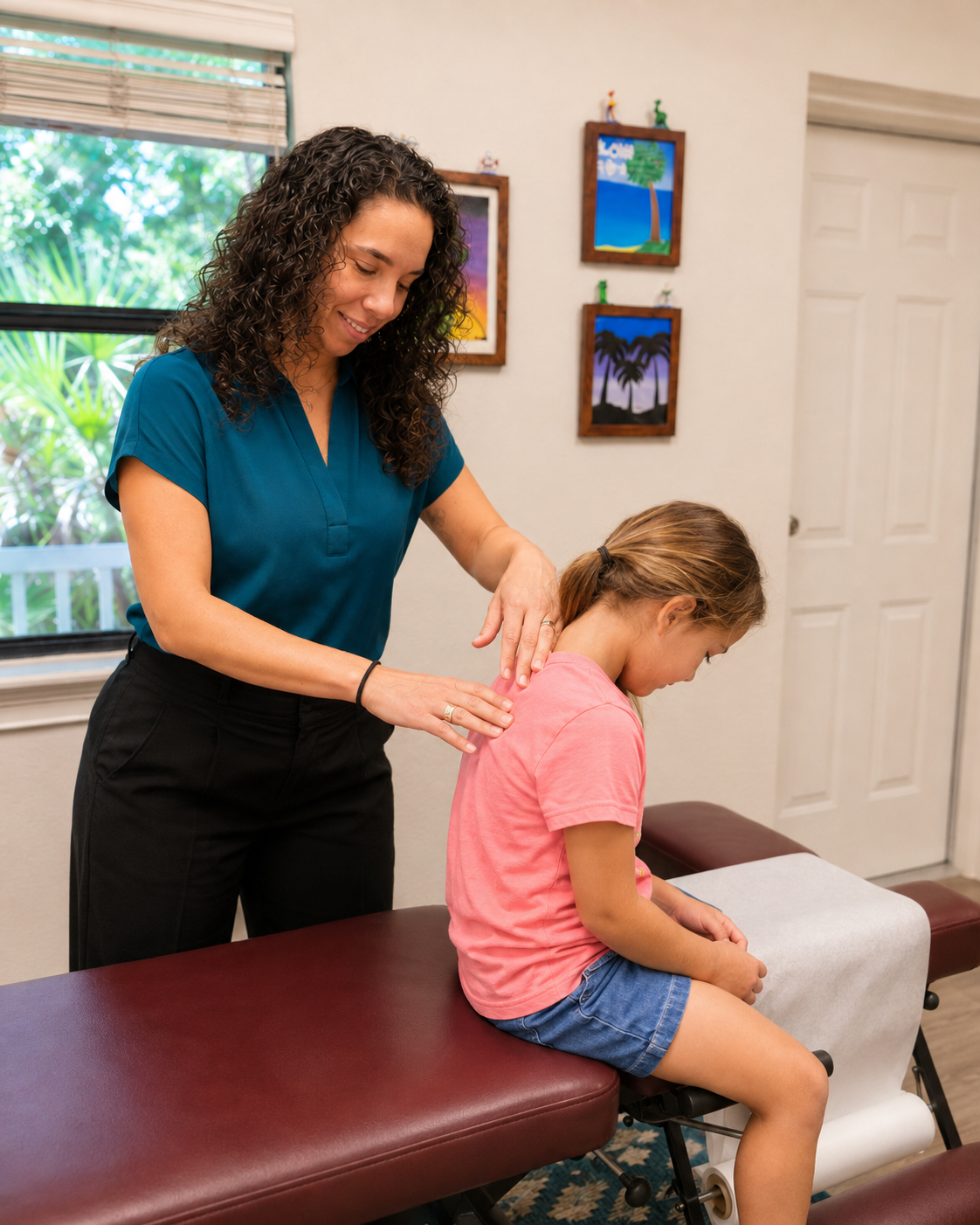
Pediatric chiropractic care focuses on the relationship between the spine, joints, movement, and nervous system. Dr. Liz may evaluate spinal and joint mobility, body symmetry, posture, movement quality, compensation patterns, balance, coordination, developmental movement history, body awareness, and nervous system regulation.
When restrictions are identified, gentle, age-appropriate chiropractic care may be used to support joint mobility, comfortable movement, movement options, body awareness, adaptability, and nervous system regulation.
The goal is not: Adjust the child and create a milestone.
The goal is: Give the body a better opportunity to move—and observe how the child uses that opportunity.
Movement Is Not the Whole Story
Sometimes Mobility Is Only One Layer
A child can have good joint mobility and still struggle with balance, coordination, sensory processing, motor planning, attention, regulation, body awareness, fine-motor skills, communication, or everyday participation.
That tells us something important. The developmental picture may involve more than the physical ability to move. That is where a deeper functional approach becomes valuable.
Primitive Reflexes
Early Automatic Movement
Children enter the world with automatic movement responses called primitive reflexes. These early patterns support important functions during infancy.
As the nervous system develops and children gain greater voluntary control, primitive reflex responses typically become less dominant while increasingly complex movement develops. Primitive reflexes therefore provide another way to observe early nervous-system organization.
When appropriate, Rooted Pathways may assess primitive reflex patterns alongside movement, coordination, balance, posture, sensory responses, body awareness, regulation, and developmental history. A primitive reflex finding is information—not a diagnosis. It should be interpreted as one piece of a much larger developmental picture.
COMING NEXT: Primitive Reflexes & Development
Motor Planning
From Idea to Action
Imagine asking a child to complete a movement they have never done before. The nervous system has to:
Understand the goal Sense the body Plan the movement Organize the sequence Perform it Feel what happened Adjust the next attempt
This process contributes to motor planning, sometimes called praxis. Children use motor planning when they learn to climb playground equipment, ride a bike, dress themselves, learn a dance, navigate an obstacle, learn a new sport, use tools, or complete unfamiliar movements.
Movement, sensation, body awareness, coordination, and experience all interact.
Regulation Makes Participation Possible
A Child Cannot Experience Development Separate From Their State
A child may have the physical ability to complete a task but struggle when their nervous system is overwhelmed. Regulation influences a child's ability to engage, transition, pay attention, explore, communicate, participate, recover after frustration, and adapt to environmental demands.
Regulation does not mean a child is always calm. Healthy children move through many states: Excited. Focused. Active. Frustrated. Calm. Tired.
Regulation involves becoming increasingly able to adapt between these states.
Behavior Is Information
Look Beneath What You Can See
Sometimes parents first notice neurodevelopment through behavior. A child may crash into everything, avoid certain movements, become overwhelmed by noise, struggle with transitions, move constantly, resist certain clothing, become frustrated during new motor tasks, or have large emotional responses.
Behavior has many possible influences. Instead of asking only: “How do we stop this?” Rooted Pathways asks: “What is happening beneath the behavior?”
We may explore sensory needs, communication, body awareness, movement, motor planning, developmental skills, environment, and regulation. Understanding does not excuse every behavior. It gives us more information about how to support the child.
Neurodevelopment Does Not End With a Diagnosis
Understand the Child Behind the Label
Some children entering Rooted Pathways may already have diagnoses such as autism, ADHD, developmental delay, speech or language disorders, coordination-related diagnoses, or sensory or learning concerns. Others may have no diagnosis at all.
A diagnosis can provide important information. But it does not tell us everything about an individual child. Two children with the same diagnosis may have very different strengths, movement patterns, communication, sensory preferences, coordination, regulation, and functional challenges.
Our goal is not to treat the label. Our goal is to understand: What does this child do well? What is difficult? What developmental patterns do we see? What would make everyday life easier or more successful?
What Is Rooted Pathways?
Looking at Development as an Integrated System
Rooted Pathways: A Neurodevelopment Program was created for children who may benefit from a deeper look at how their movement, sensory experiences, regulation, primitive reflexes, body awareness, coordination, and everyday function work together.
Pediatric Chiropractic
Supporting spinal and joint mobility, movement, body awareness, and the physical foundation for development.
Pediatric Occupational Therapy
Helping translate sensory-motor development into meaningful everyday function.
Primitive Reflexes
Looking at early automatic movement patterns as one component of the developmental picture and providing individualized activities when appropriate.
Developmental Movement
Creating opportunities to practice movement experiences relevant to the child's needs.
Sensory & Proprioceptive Regulation
Helping understand how the child receives, seeks, avoids, and responds to sensory information.
Home Activities & Reassessment
Giving families practical ways to reinforce developmental experiences, tracking function over time, and adjusting the approach.
The Rooted Pathways Developmental Framework
From Foundation to Function
MOBILITY
Can the body move comfortably?
SENSORY INPUT
What information is the nervous system receiving?
BODY AWARENESS
Can the child organize where their body is in space?
MOTOR PLANNING
Can the nervous system create and sequence an action?
COORDINATION
Can multiple body regions work together efficiently?
REGULATION
Can the child adapt their state to the demands around them?
PARTICIPATION
Can the child use these abilities during real life?
Function Is the Goal
Not a Perfect Child. Not a Perfect Reflex Score.
The goal of neurodevelopmental support should not be creating a child who looks exactly like every other child. We are not looking for perfect posture, perfect symmetry, perfect behavior, perfect reflex scores, or a child who never gets overwhelmed.
We are looking for meaningful changes in function. Depending on the child, that might mean:
- Moving with greater confidence
- Participating more easily
- Developing better body awareness
- Improving coordination
- Managing transitions more successfully
- Tolerating new experiences
- Becoming more independent
- Feeling more comfortable in their body
The goals should matter in the child's real life.
Development Is Not Linear
Progress Can Take Different Paths
Children develop differently. Progress may happen quickly in one area and slowly in another. A child may learn a skill, stop using it temporarily, and later return to it with greater complexity.
Growth, environment, practice, health, sensory experiences, relationships, and individual neurological development all influence the process. Neurodevelopment is dynamic.
That is why Rooted Pathways focuses on reassessment rather than assuming every child follows the same protocol.
What Neuroplasticity Does Not Mean
Adaptability Is Powerful—but It Is Not a Promise
Neuroplasticity does not mean every developmental condition can be reversed, every child responds to the same intervention, more stimulation is always better, a specific exercise rewires one specific part of the brain, chiropractic adjustments cure neurodevelopmental diagnoses, or primitive reflex integration cures autism or ADHD.
Neuroplasticity means the nervous system has the capacity to adapt through experience. Our responsibility is to create developmentally appropriate opportunities and observe how the individual child responds.
When Additional Care Is Part of the Path
Supporting Development Can Be Collaborative
Rooted Pathways may be one part of a child's broader developmental support. Depending on the child, families may also work with professionals involved in medical evaluation, speech and language, physical rehabilitation, behavioral or emotional health, education, developmental services, or other specialized care.
We do not need every professional to do the same thing. Each discipline can contribute a different perspective while working toward meaningful goals for the child.
Explore the Neurodevelopmental Pathways
More Neurodevelopment Resources Coming Soon:
- AUGUST 12: Primitive Reflexes & Development
How automatic early movement patterns relate to developing voluntary control. - AUGUST 19: Autism & Neurodevelopmental Support
A strengths-based look at movement, sensory experiences, regulation, coordination, and participation in autistic children. - AUGUST 26: ADHD, Attention & Regulation
Understanding attention through regulation, sensory input, movement, executive function, and individual needs. - SEPTEMBER 9: Motor Planning, Coordination & Body Awareness
How the nervous system senses, plans, performs, and adapts movement. - SEPTEMBER 16: Speech, Communication & Development
Looking at communication within the broader developmental system. - SEPTEMBER 23: Emotional Regulation & Meltdowns
Understanding what may be happening beneath big emotional and behavioral responses.
Related Resources
Developmental Milestones & Concerns
Understand how developmental patterns progress across movement, communication, learning, and regulation.
Crawling & Movement Concerns
Explore how early movement provides sensory-motor experiences and why movement quality matters.
Sensory & Regulation Challenges
Learn how children receive and respond to information from their body and environment.
Attention, Behavior & Neurodevelopment
Look beneath attention and behavior to understand broader developmental patterns.
Ready to Look Deeper Into Your Child’s Development?
Development is more than a checklist. It is a constantly evolving conversation between brain, body, movement, sensation, environment, and experience. At Rooted Pathways, we bring those pieces together so families can better understand how their child is developing.